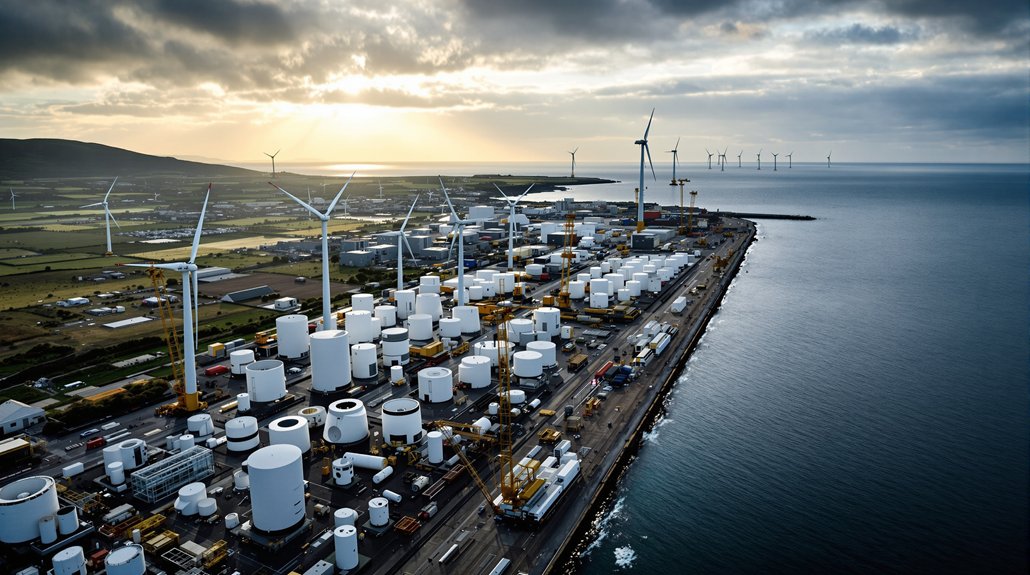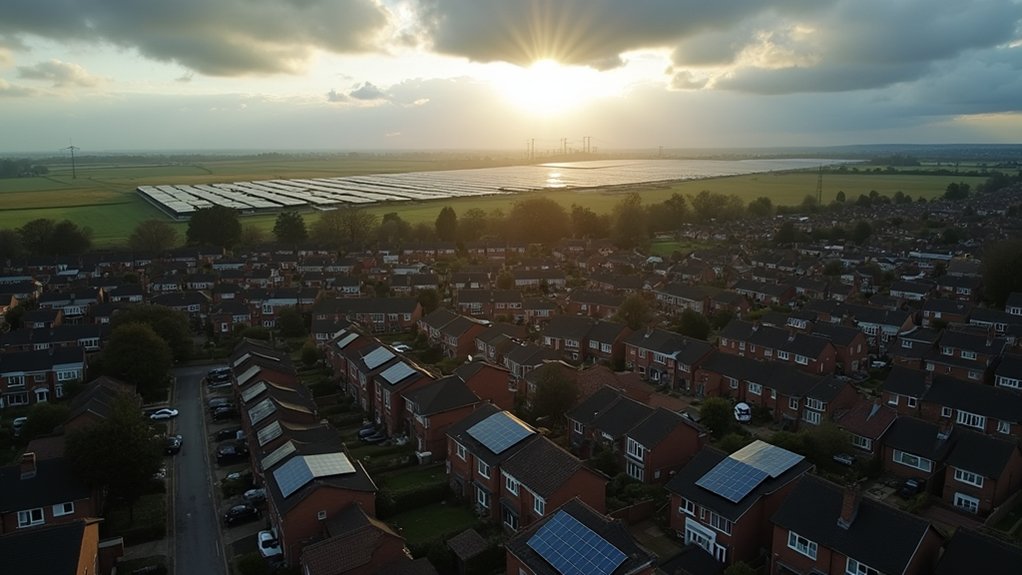

While the UK has historically lagged behind European counterparts in solar adoption, the government’s ambitious “rooftop revolution” aims to dramatically reverse this trend by tripling national solar capacity before 2030. The initiative represents a cornerstone of Labour’s broader decarbonisation strategy, which simultaneously targets doubling onshore wind capacity and quadrupling offshore installations within the same timeframe.
The plan calls for significant regulatory reforms to accelerate deployment across millions of UK homes. Perhaps most vital is the government’s decision to raise the transmission impact assessment threshold from 1MW to 5MW, eliminating a notorious bottleneck that has stalled numerous community-scale projects. I’ve observed similar policy shifts deliver remarkable results in comparable markets.
Regulatory bottleneck removal through raised transmission thresholds promises to unleash community solar potential across the UK.
Economic benefits for consumers stand at the forefront of the revolution’s appeal. Households installing panels can expect substantial reductions in energy bills through self-generation, while the forthcoming Warm Homes Plan promises government-backed funding for solar installations beginning in 2025. The upfront cost barrier, long the primary obstacle to widespread adoption, appears set for meaningful reduction. Eligible households with low EPC ratings in bands D to G will particularly benefit from this funding scheme.
Three recently approved large-scale solar farms underscore the multifaceted approach, with these installations alone expected to deliver two-thirds of last year’s combined rooftop and ground-mounted solar output. These utility-scale projects complement the distributed generation model at the heart of the rooftop strategy.
Planning permission requirements are undergoing extensive streamlining, particularly for existing homes. Special attention is being directed toward conservation areas and listed buildings, where installation restrictions have historically limited deployment potential.
The National Energy System Operator will spearhead grid connection reforms essential to the initiative’s success. These changes will primarily benefit England and Wales, with Scotland and Northern Ireland operating under separate grid systems that require alternative approaches.
The environmental implications cannot be overstated. Localised solar production reduces transmission losses, improves system efficiency, and accelerates progress toward legally binding net zero targets. Energy Secretary Ed Miliband has defended the development of solar farms against criticisms, emphasizing the critical importance of decarbonized power over concerns about food production reduction.
Despite inevitable implementation challenges, the rooftop revolution represents a decisive step toward energy independence and climate resilience.