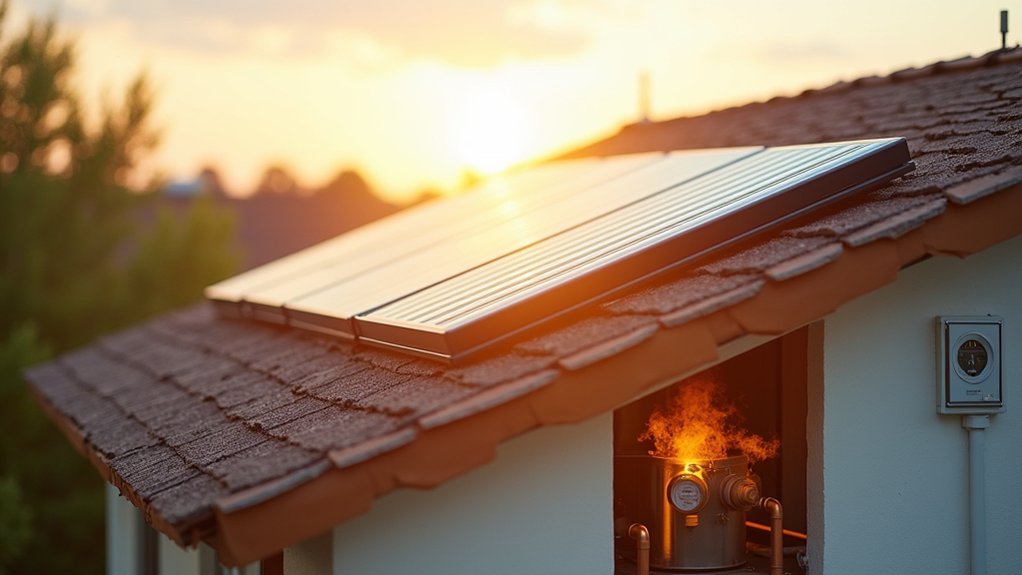
Most homeowners are unaware that investing in solar water heating systems can slash utility bills by up to 90% while providing decades of reliable service. The initial investment ranges between $1,500 and $3,500 for the equipment, with installation adding another $1,000 to $3,000.
Though conventional electric and gas heaters cost considerably less upfront—typically $150 to $450—they represent a penny-wise, pound-foolish approach to household energy management.
The economics become compelling when examining the long view. Solar water heating systems generate annual savings of $500 to $800 compared to electric alternatives and $300 to $600 versus gas systems. This efficiency translates to complete investment recovery within 4 to 8 years, after which the savings accumulate as pure financial benefit. A typical installation can reduce water heating bills by 50% to 80% depending on your geographic location and usage patterns.
I’ve analyzed dozens of household energy systems, and few investments offer this combination of reliable returns and operational simplicity.
These systems demonstrate remarkable durability, functioning efficiently for over 20 years with minimal maintenance requirements. Traditional water heaters, by comparison, require more frequent replacement and ongoing maintenance, creating hidden costs that solar solutions eliminate.
The durability advantage can’t be overstated—it’s like comparing a workhorse to a showpony.
Environmental benefits compound the financial advantages. A single solar water heater prevents approximately 50 tons of carbon dioxide emissions over its operational lifetime, contributing considerably to residential carbon footprint reduction.
This sustainable energy approach uses no fuel and produces zero pollution during operation.
Government recognition of these benefits has resulted in considerable economic incentives. Federal and state tax breaks, utility rebates, and mortgage benefits can dramatically reduce initial investment costs. A federal tax credit of 30% of the total system cost is available through 2032, significantly offsetting the upfront expense.
Additionally, these installations increase property values and support domestic job creation in the renewable energy sector.
Technological advancements continue to improve system efficiency while reducing equipment costs. Modern designs maximize energy capture through sophisticated engineering, and integration capabilities allow these systems to work harmoniously with other solar technologies.
For forward-thinking homeowners seeking energy independence, solar water heating represents both immediate savings and long-term energy security.