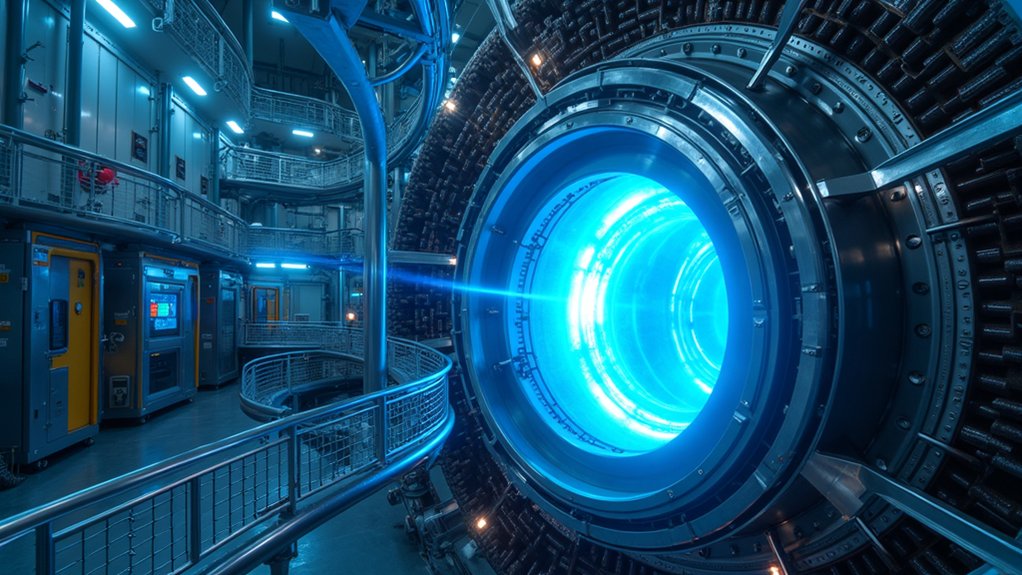

While the world races toward sustainable energy solutions, China’s Huanliu-3 (HL-3) tokamak reactor in Chengdu has quietly achieved remarkable milestones in the pursuit of controlled nuclear fusion. The reactor recently attained extraordinary plasma temperatures of 117 million °C for ions and 160 million °C for electrons, substantially exceeding the Sun’s core temperature. These aren’t merely numbers on a display—they represent fundamental progress toward fusion ignition conditions.
China’s HL-3 tokamak achieves fusion plasma temperatures exceeding 160 million °C—far hotter than the Sun’s core and a crucial step toward ignition.
The HL-3’s technological arsenal includes a self-developed microwave gyrotron injecting 2.5 MW of heating power and dual neutral beam injection systems delivering 14 MW combined. This heating infrastructure, coupled with a precision high-voltage DC power supply operating at 120 kV, has enabled the reactor to reach high-confinement mode (H-mode) with plasma currents of 1 MA. The H-mode operation follows successful experiments on the earlier HL-2A tokamak, which provided crucial experience for the HL-3 team. The triple product—a vital fusion performance metric combining density, temperature, and confinement time—has seen substantial gains.
China’s achievement places it among global fusion leaders, with HL-3 contributing valuable data to international projects including ITER. The reactor’s collaborative nature, involving 17 international laboratories, exemplifies fusion research’s inherently cooperative approach. The facility’s participation in the broader ITER network strengthens global fusion research efforts through knowledge sharing. Diagnostic systems throughout the device monitor performance with unprecedented precision, allowing researchers to fine-tune parameters for ideal plasma behavior.
Despite these impressive benchmarks, practical fusion power remains elusive. The reactor currently consumes more energy than it produces, a challenge faced by all fusion devices worldwide. The shift from “physics experiments” to “power plants” requires overcoming significant engineering hurdles in materials science and plasma stability.
The HL-3 has entered what scientists term the “combustion experiment” stage—a significant step toward self-sustaining fusion reactions. Commercial fusion energy likely remains at least a decade away, but China’s progress accelerates the timeline.
The national strategic significance of these achievements extends beyond energy production, positioning China at the forefront of a technology that could fundamentally transform global energy systems. The fusion race continues, with HL-3’s scorching temperatures lighting the way.