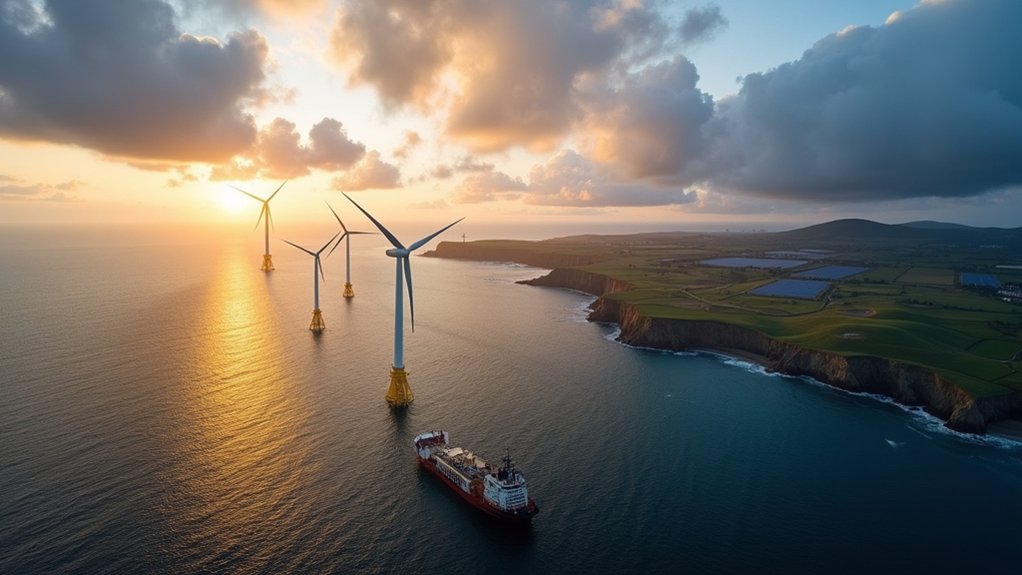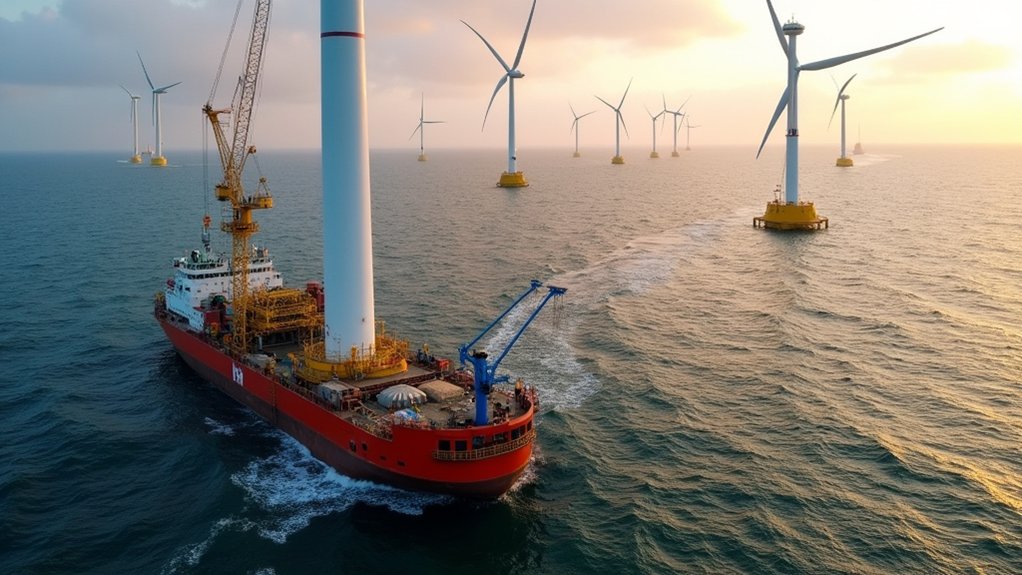
Dozens of massive turbines will soon punctuate the horizon off England’s Suffolk coast as Iberdrola commences construction of the East Anglia 3 offshore wind farm. The ambitious project leverages cutting-edge wind energy technology, with turbines expected to reach heights exceeding 270 meters from seabed to blade tip. I’ve observed few renewable projects with such thorough planning and technical sophistication in the marine environment.
The East Anglia 3 development began with meticulous site selection, considering seabed geology, wind potential, and environmental impact assessments. Engineers conducted extensive feasibility studies using advanced modeling techniques to optimize turbine placement for maximum energy capture.
Site selection excellence: where geology, wind profiles, and environmental factors converge through data-driven turbine positioning
Seabed conditions particular to the Suffolk coast determined the foundation systems selected for the project, with monopiles likely chosen for shallower sections and jacket foundations for deeper waters. The selection of appropriate foundation methods is critical as they must be designed to withstand harsh marine conditions throughout the project’s operational lifetime.
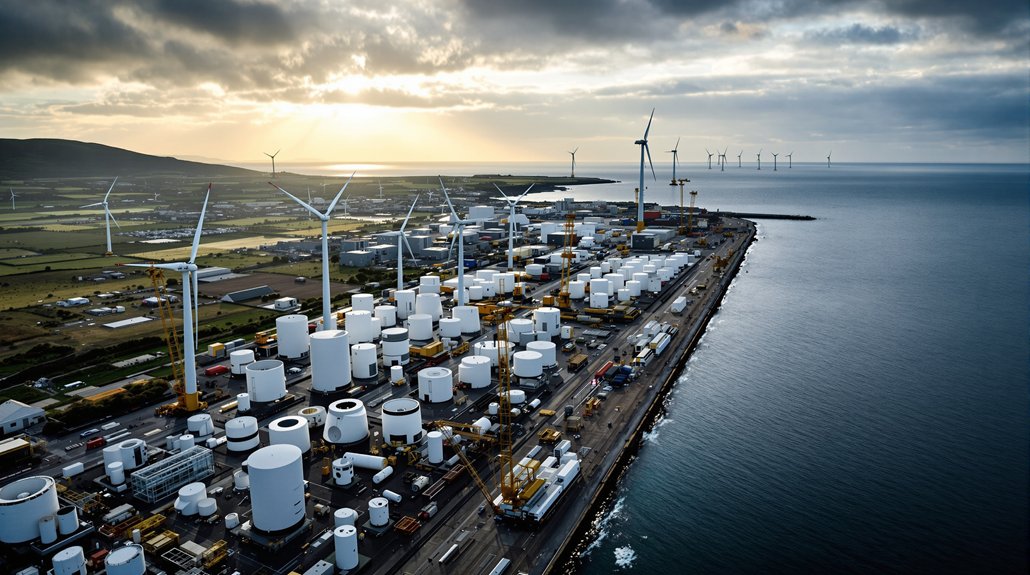
Component manufacturing is underway at specialized industrial facilities where precision fabrication occurs under controlled conditions. These massive elements, including marine electrical substations weighing upwards of 8,000 tonnes, will be transported to designated logistics centers before deployment.
The scheduling intricacies alone represent a masterclass in project management.
Installation will utilize specialized jack-up barges equipped with heavy-lift cranes capable of precise positioning in challenging marine conditions. The foundations must be installed with millimeter accuracy, followed by connection pieces housing auxiliary equipment and providing the essential connection to turbine towers.
The electrical infrastructure represents perhaps the most technically demanding aspect of East Anglia 3. Submarine cables with varying cross-sections will connect individual turbines in sophisticated networks, ultimately linking to marine substations that consolidate power before transmission to shore.
Cable laying operations require specialized vessels operating in synchronized choreography, hardly the simple procedure some might imagine.
Weather conditions will inevitably influence the construction timeline, as marine operations demand specific environmental parameters for safety. Iberdrola’s team must coordinate multiple installation vessels, supply chains, and technical crews amidst the North Sea’s notorious volatility.
The resulting wind farm, however, will stand as proof of engineering ingenuity in harsh marine environments.