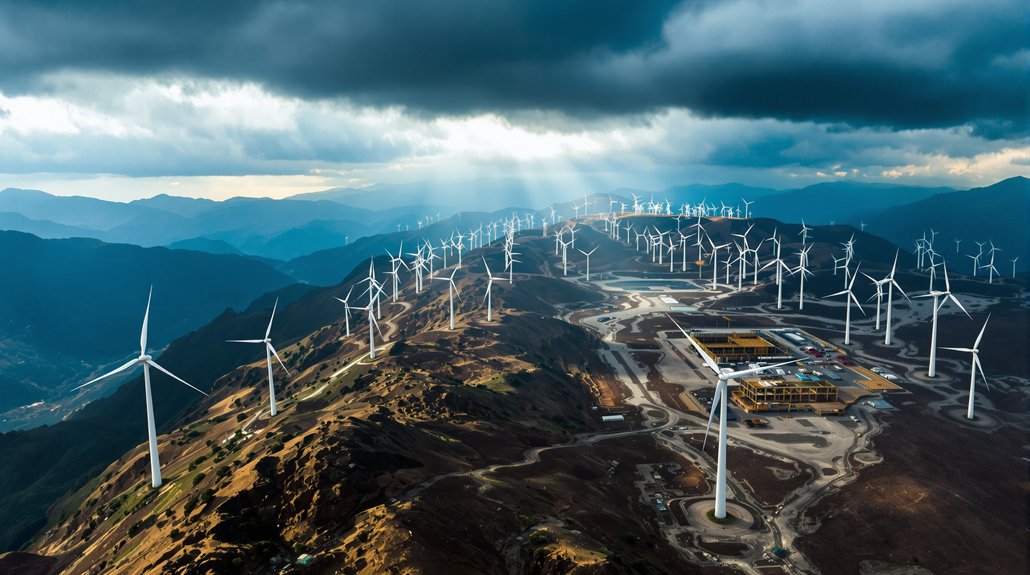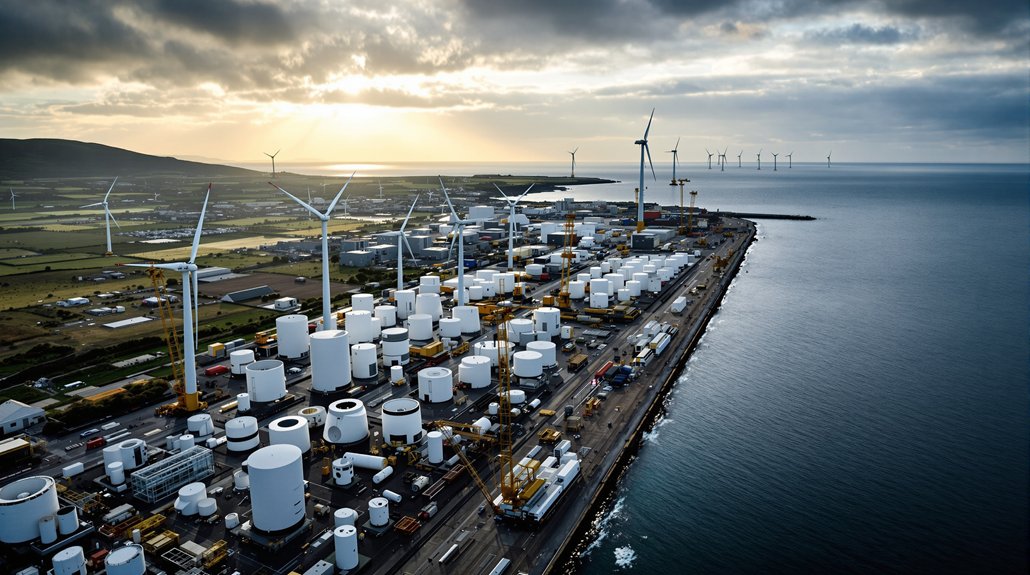
Ireland’s ambitious climate agenda has positioned onshore wind energy at the forefront of its renewable shift, with the Climate Action Plan setting a formidable target of 9 GW capacity by 2030. This represents the centerpiece of Ireland’s renewable electricity strategy, supplemented by 5 GW of offshore wind and 8-9 GW of solar capacity. The nation’s commitment has evolved slightly from earlier government statements that cited an 8.2 GW onshore wind target.
Onshore wind stands as the cornerstone of Ireland’s climate strategy, with ambitious 9 GW targets anchoring the nation’s renewable electricity vision.
Current progress, however, paints a concerning picture. By late 2024, Ireland has secured just over 5 GW of onshore wind capacity, counting both existing installations and contracted projects. The recent RESS 4 auction delivered a mere 374 MW across four wind projects, considerably underperforming compared to solar’s 960 MW. This procurement rate falls well short of the trajectory needed to meet the 2030 goals.
The challenges are substantial and systemic. Planning permission bottlenecks, grid connection delays, and infrastructure limitations have created a perfect storm of impediments. SEM already boasts the highest wind generation contribution of any power system globally, making further integration increasingly complex. Industry experts suggest these barriers could postpone target achievement by three years. Cornwall Insight’s analysis warns that Ireland may achieve only 74% renewable generation by 2030 instead of the targeted 80%.
The math simply doesn’t add up—Ireland needs to add roughly 4 GW in six years, yet current procurement mechanisms aren’t delivering sufficient capacity.
Economic benefits from wind expansion remain compelling. Ireland has established itself as a global per-capita leader in onshore wind electricity. Beyond environmental gains, the sector offers substantial rural development and employment opportunities. Yet these advantages remain theoretical without implementation acceleration.
Current modeling projects Ireland reaching only 66% renewable electricity by 2030, far below the stated 80% ambition. SEM analysis suggests the 80% threshold might not be crossed until 2033.
The gap between rhetoric and reality grows increasingly apparent. Without immediate, decisive action to reform planning processes, expedite grid development, and enhance the effectiveness of RESS auctions, Ireland’s wind ambitions risk becoming mere aspirational targets rather than achievable goals. The clock is ticking.