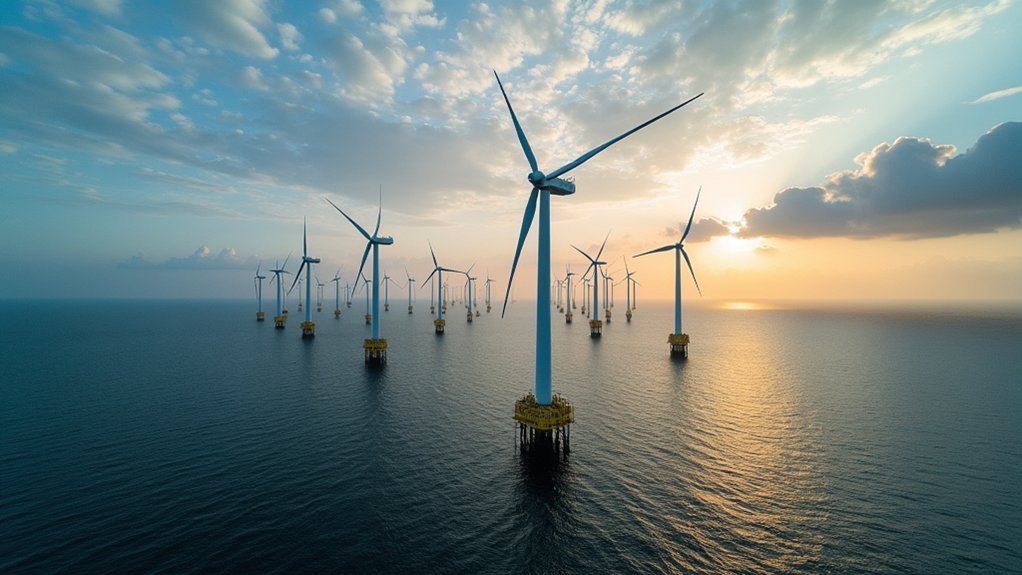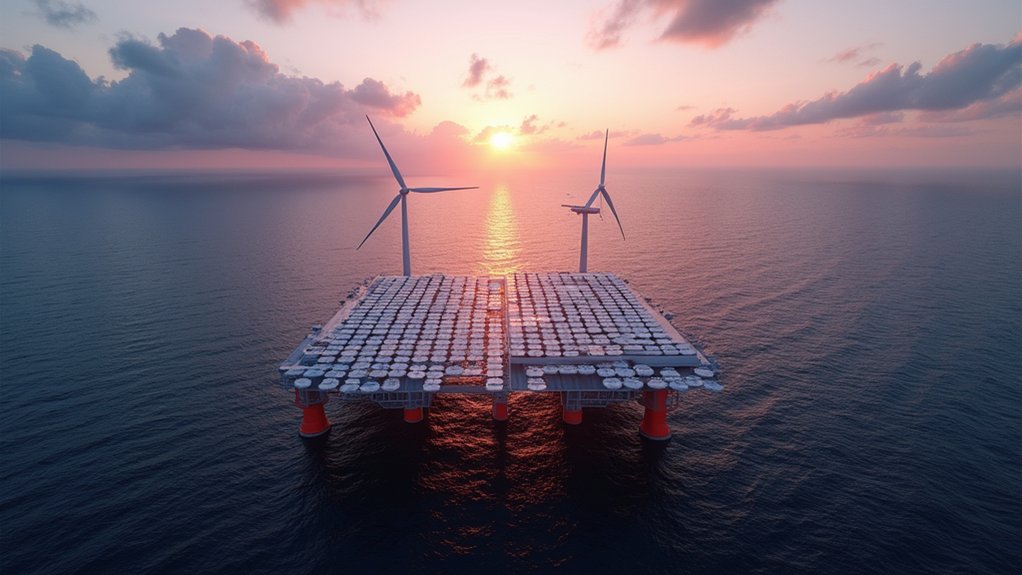
As traditional wind turbines reach their physical limits in size and efficiency, multi-rotor turbine technology emerges as a promising frontier in renewable energy innovation. Market projections indicate a compound annual growth rate of 6.7% by 2031, with the UK expected to deploy 40-rotor structures offshore between 2030 and 2040. Companies like Wind Catching Systems are already developing concepts featuring up to 100 rotors per structure, signaling rapid industry adoption.
The performance advantages are compelling. Vestas’ four-rotor prototype demonstrated a 1.5% increase in annual energy production compared to equivalent single-rotor designs. These systems achieve improved power curves, reaching nominal output faster than conventional turbines—an efficiency boost that translates directly to revenue. Wake steering capabilities in multi-rotor configurations also reduce those pesky power losses that plague standard wind farms.
Multi-rotor technology delivers superior power curves, faster output ramp-up, and reduced wake losses—transforming efficiency into revenue.
Space utilization represents another significant advantage. Five large multi-rotor units can match the output of 25 standard turbines while requiring substantially less seabed area. I’ve analyzed the logistical constraints of traditional turbines, and multi-rotor designs elegantly solve many of these issues. Smaller rotors are simply easier to transport and install than the increasingly unwieldy blades of conventional designs. The industry faces major transport challenges as conventional turbine blade sizes continue to exceed vessel capacities.
The redundancy built into multi-rotor systems creates unprecedented reliability. When a single rotor fails, only a fraction of potential output is lost, unlike conventional turbines that experience total shutdown. The failure of a single rotor causes only a small percentage loss of overall power generation. Maintenance can be performed on individual rotors while others continue generating, maintaining cash flow even during service periods.
Economic benefits accumulate rapidly. The dense layout possibilities reduce installation and seabed lease costs, while improved reliability decreases downtime-related losses. These advantages contribute to a reduced Levelised Cost of Energy, the industry’s definitive metric for profitability.
German prototype Nezzy2, already tested at 1:10 scale, demonstrates the commercial potential of this approach. With engineering focus shifting toward offshore-ready platforms adaptable to harsh conditions, multi-rotor turbines are positioned to transform the UK’s wind energy landscape through improved economics and operational resilience.