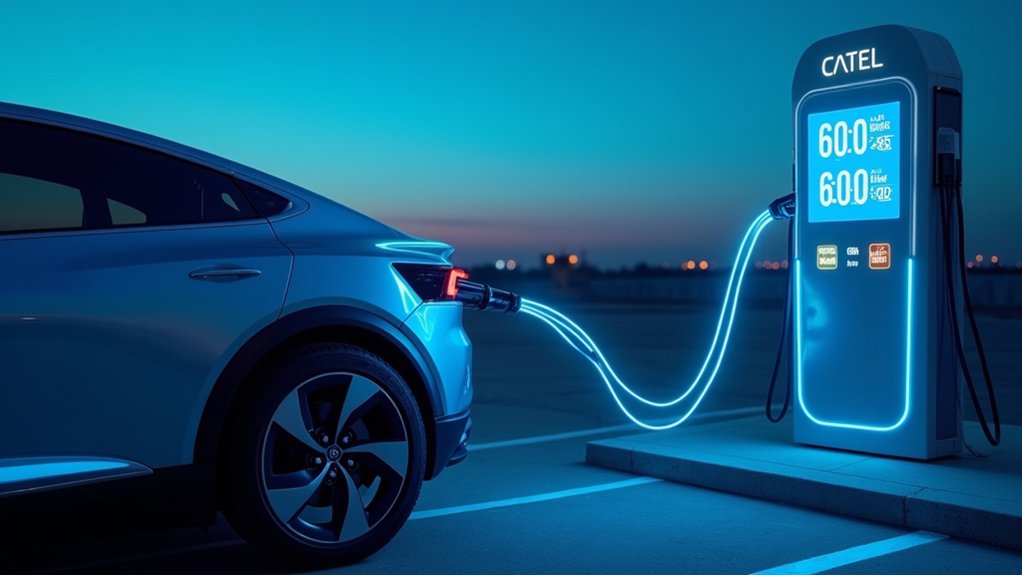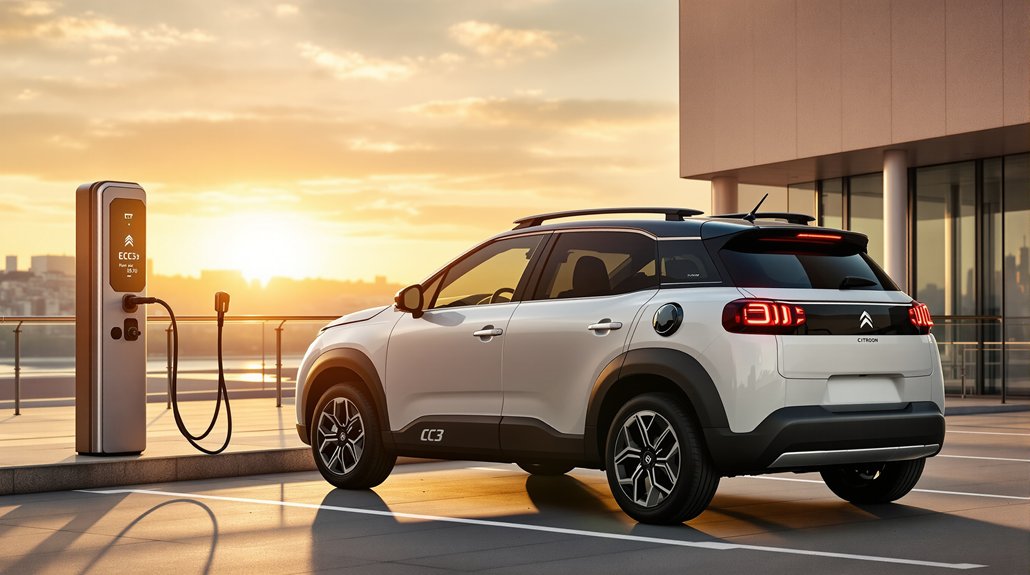

While public charging stations continue to expand across the nation, the economics of home charging remains one of the most compelling advantages for electric vehicle owners. At an average of $0.16 per kilowatt-hour across the U.S., home charging typically costs 52% less than public charging rates, which hover around 34.2 cents per kWh. This dramatic difference translates to considerable savings for the 80% of EV owners who choose to plug in at home.
The equation isn’t always so straightforward, however. Regional variations create a complex landscape of charging costs. Residents in Washington state enjoy rates as low as $0.11/kWh, while Hawaiian EV owners face a steep $0.41/kWh—nearly four times higher. California and Connecticut fall somewhere in between at approximately $0.31/kWh.
The EV charging landscape varies drastically—from Washington’s economical $0.11/kWh to Hawaii’s steep $0.41/kWh premium.
These variations mean the same Tesla Model 3 Long Range requiring 75 kWh for a full charge might cost $8.25 in Washington but a whopping $30.75 in Hawaii.
Initial infrastructure investments represent another notable expense often overlooked in charging calculations. A Level 2 charging setup, including equipment and installation, typically ranges from $1,200 to $2,500. The average installation alone runs $965, with costs heavily dependent on electrical panel capacity, wiring distance, and local labor rates. Many EV owners can take advantage of state and local rebates to offset these installation costs. If you encounter issues accessing information about services online, you may need to contact providers directly due to security measures that sometimes restrict website access.
Older homes may require additional electrical service upgrades, further increasing upfront expenses.
Vehicle efficiency plays a vital role in determining ongoing charging costs. The 2025 GMC Hummer EV exemplifies this with its enormous 212.7 kWh battery requiring $36.16 for a full charge—over three times more than the Volkswagen ID.4’s $10.54 charge cost.
Smart consumers calculate their specific costs by multiplying their vehicle’s energy consumption per 100 miles by their local electricity rate.
To maximize savings, EV owners should take advantage of utility time-of-use plans and EV-specific rates when available. The growth of smart charging technology is making it easier for homeowners to optimize electricity usage and reduce costs. Scheduling charging during off-peak hours can slash costs remarkably, sometimes by more than 50%.
Tracking consumption patterns and adjusting charging habits accordingly guarantees the promised economic benefits of electric vehicle ownership are fully realized.