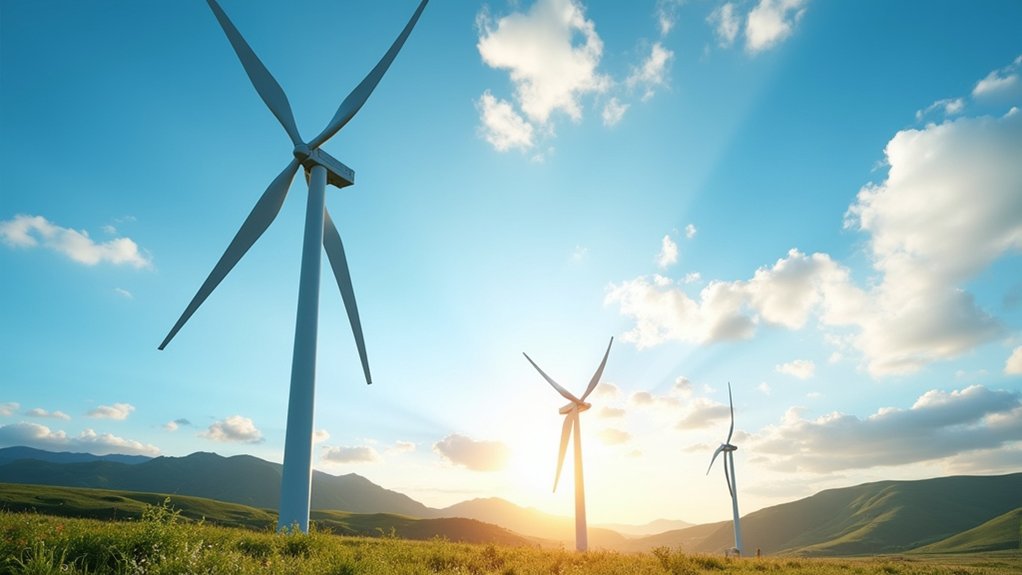

While most people recognize wind turbines as towering structures dotting landscapes worldwide, few understand the sophisticated mechanics behind their mesmerizing rotation. These engineering marvels harness kinetic energy through a deceptively simple process: wind creates pressure differentials across blade surfaces, generating lift that exceeds drag forces, thereby initiating rotation. The typical wind turbine rotor operates at a leisurely 8-20 RPM—a cadence that belies the complex systems converting this motion into usable electricity.
Contrary to popular belief, turbines don’t universally rotate in one direction. Both clockwise and counterclockwise rotations exist across different installations, determined largely by manufacturer specifications rather than geographical location. This variability stems from design choices that consider mechanical logistics, maintenance protocols, and occasionally, site-specific wind patterns. I’ve observed that blade direction doesn’t greatly impact overall energy output when comparing similar turbine designs under equivalent conditions.
Wind turbines spin both ways—a manufacturer’s choice shaped by logistics rather than performance concerns.
The rotation mechanics involve a sophisticated drivetrain where the hub transfers rotational energy through low-speed shafts into a gearbox. This essential component transforms the slow, torque-heavy rotor movement into higher-speed rotation suitable for electricity generation, typically increasing RPM by a factor of 90-120. Modern horizontal-axis turbines, with their distinctive three-blade design, dominate commercial installations due to their efficiency and reliability.
The wake behind spinning turbines actually rotates counter to the blades due to aerodynamic principles, creating vortex structures that influence downstream air dynamics.
Yaw and pitch systems play vital roles without affecting inherent rotation direction. The yaw drive orients the nacelle toward prevailing winds, while pitch mechanisms adjust blade angles to optimize energy capture or protect equipment during excessive wind events. Some turbines utilize direct-drive systems that eliminate the gearbox entirely, connecting the rotor directly to the generator for increased efficiency and reduced maintenance requirements. Each manufacturer’s approach to these systems creates subtle variations in operational characteristics.
Wind farms with mixed-direction turbines create fascinating wake interaction patterns. These interactions occasionally influence efficiency when turbines operate in close proximity, particularly under specific wind regimes featuring Ekman spirals or veering conditions.
Despite this complexity, rotation direction remains mainly a manufacturer decision rather than a performance optimization—an engineering choice that exemplifies the nuanced design considerations behind these remarkable renewable energy workhorses.