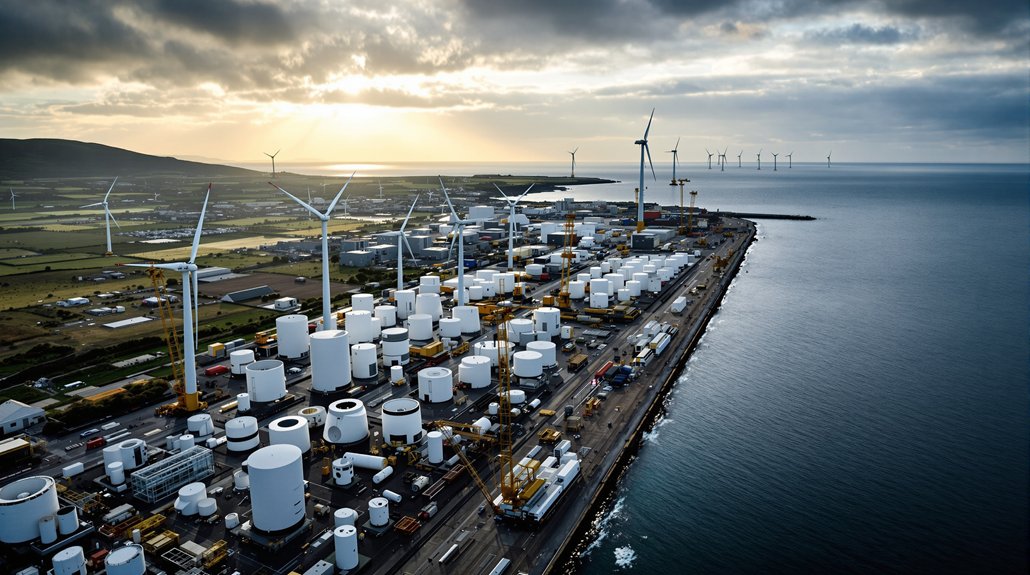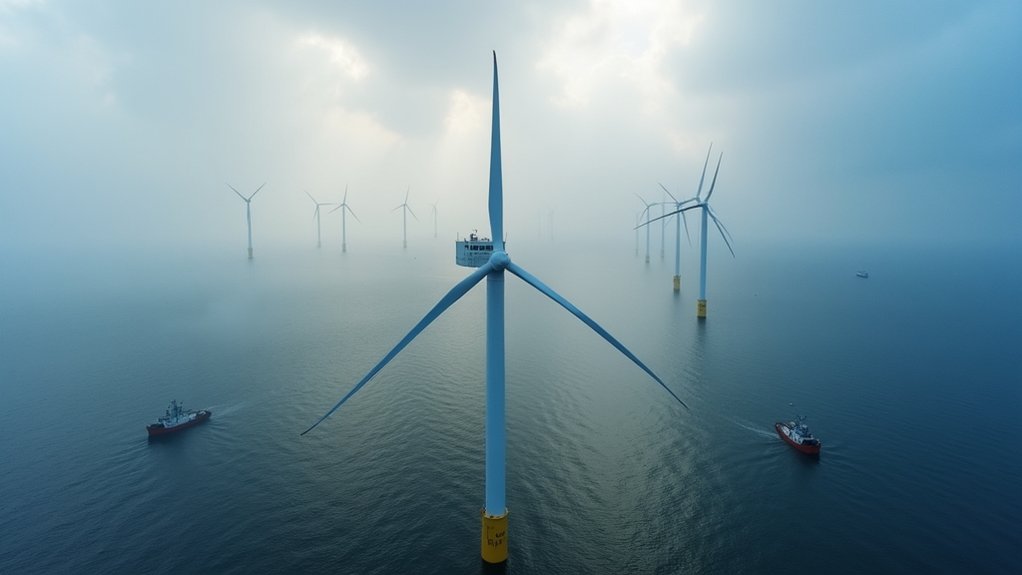

As Germany accelerates its shift to renewable energy sources, the He Dreiht offshore wind farm is emerging as a landmark project in the North Sea, approximately 85 km northwest of Borkum and 110 km west of Helgoland. Developed by EnBW with participation from Allianz Capital Partners, AIP, and Norges Bank Investment, this installation represents a significant milestone in the country’s energy evolution strategy. The scale is impressive—over 60 vessels are currently involved in the construction process.
The first of 64 Vestas V236-15.0 MW turbines was installed in April 2025, marking a global technical achievement. These are currently the largest offshore wind turbines available on the market, with each rotation generating enough electricity to power four households for a day. The technical specifications are remarkable; the completed farm will boast a total installed capacity of 960 MW without requiring any government subsidies. The project follows similar developments like Vattenfall’s Nordlicht 1, which will be Germany’s largest offshore wind project when construction begins in 2026.
All turbine foundations were successfully installed in 2024, with internal wind farm cabling proceeding simultaneously with turbine installation. Components are loaded in Esbjerg, Denmark, then transported via a 12-hour sea journey to the construction site where the installation vessel Wind Orca handles the precise positioning of these massive structures.
Upon completion, He Dreiht will generate sufficient clean electricity to power approximately 1.1 million homes, comparable to a conventional power plant’s output. This represents EnBW’s largest offshore wind project to date, building on their 15 years of sector experience and advancing their goal to expand their renewables portfolio from 6.6 GW to over 10 GW by 2030. The company received certification contract awards for He Dreiht in July 2021, ensuring the project meets rigorous industry standards.
The project’s significance extends beyond Germany’s borders. As the first global deployment of Vestas 15 MW turbines, He Dreiht establishes new industry standards for turbine size and output while demonstrating the viability of unsubsidized utility-scale renewable energy.
The successful implementation of this technology will likely catalyze similar large-scale offshore developments throughout Europe and beyond, reinforcing Germany’s leadership position in renewable energy innovation.