While traditional wind farms dot America’s landscape with massive turbines, a revolutionary technology is quietly taking to the skies above. High-altitude kite systems are demonstrating remarkable efficiency advantages, generating up to ten times more energy per unit of material than their ground-based counterparts. I’ve examined the data, and the physics is compelling—wind power increases by the cube of wind speed, making these elevated systems extraordinarily productive.
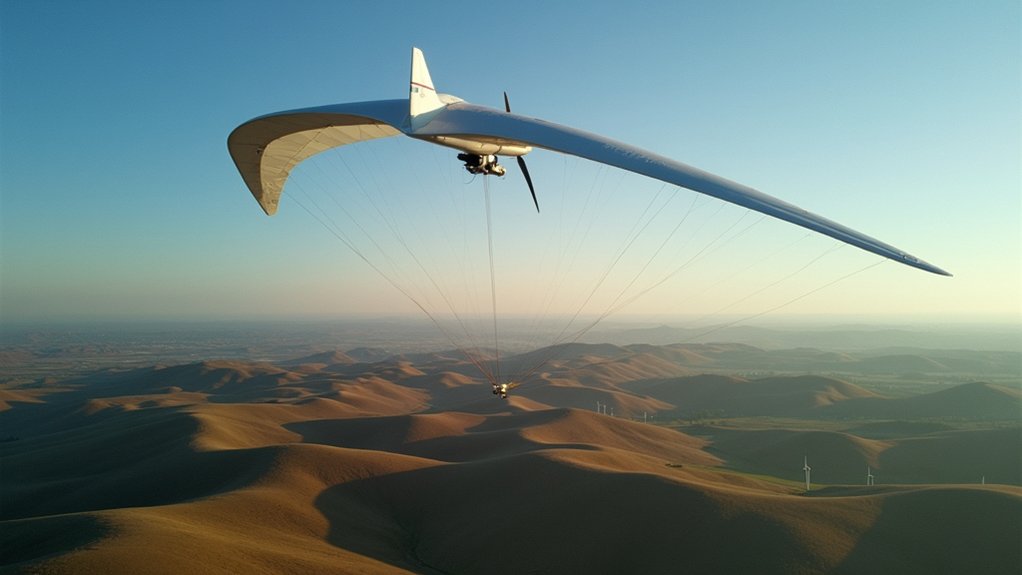
The typical configuration employs a parachute-like wing of approximately 150 square meters, tethered to a ground-based generator. Smart autonomous software guides these kites in figure-eight patterns that maximize tension on the tether, efficiently converting mechanical pull into electricity. These energy systems use intelligent control systems that automatically adjust flight paths during low wind periods or unsafe weather conditions. The tethers themselves are engineering marvels, incorporating copper wire and carbon fiber for peak strength and conductivity.
Autonomous kites dance in figure-eights, pulling carbon-fiber tethers that transform high-altitude wind into earthbound electricity.
These systems require substantially less steel and concrete than conventional turbines, dramatically reducing their carbon footprint. The minimal floor space needed makes them suitable for deployment in locations where terrain challenges would normally preclude renewable installations. Their packable nature allows for rapid deployment and retrieval in response to changing weather conditions.
Initial U.S. test results are promising. The kites deliver more full-load hours than conventional turbines due to the consistent wind speeds at higher altitudes. Operating at up to 750 meters altitude, these kites can access stronger and steadier winds than traditional turbines limited to 200 meters. They typically need to land only about 14 times annually—usually for heavy rain or unsuitable winds—minimizing downtime and maximizing generation potential.
The economic case is compelling, too. These systems are often cheaper than diesel generation in remote locations, even at this early stage of development. Lower material and installation costs, particularly in difficult terrain, suggest a high potential return on investment.
Perhaps most impressive is their environmental footprint. By operating high above the ground, these kites avoid many of the wildlife and habitat impacts associated with ground-based wind farms. They represent a genuinely innovative approach to renewable energy—one that leverages natural forces with minimal resource consumption.
The future of wind energy might not be firmly planted on the ground, but dancing efficiently in the skies above.