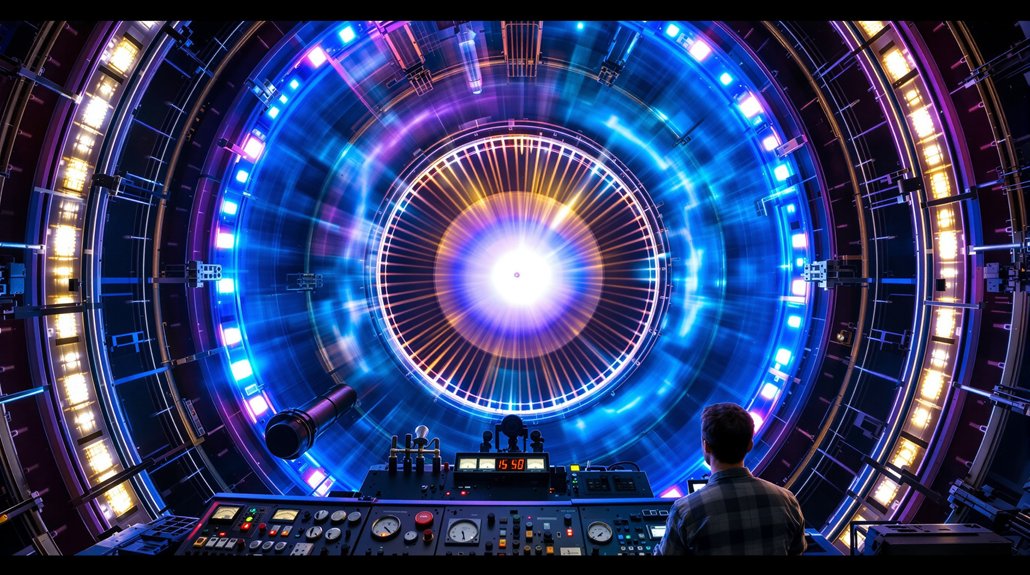
While nuclear fusion has remained an elusive dream for decades, China’s Experimental Advanced Superconducting Tokamak (EAST) has shattered previous records by maintaining high-confinement plasma for an unprecedented 1,066 seconds. This remarkable achievement, executed in a doughnut-shaped chamber using magnetic confinement, more than doubles the previous world record of 403 seconds set by the same facility in 2023.
China’s fusion breakthrough shatters records, sustaining plasma for 1,066 seconds—a quantum leap toward clean energy’s holy grail.
The experiment’s significance cannot be overstated. EAST sustained plasma at temperatures exceeding 180 million degrees Celsius—hotter than the sun’s core—for over 17 minutes. The steady-state, high-confinement mode represents a quantum leap toward practical fusion energy implementation. The achievement follows significant system upgrades, including a doubled heating power that enabled the record-breaking performance. This breakthrough was achieved by the Institute of Plasma Physics under the Chinese Academy of Sciences. I’ve tracked fusion developments for years, and this breakthrough positions China at the vanguard of global efforts.
Nuclear fusion offers the tantalizing prospect of near-limitless clean energy with minimal radioactive waste and greenhouse gas emissions. Unlike its fission counterpart, fusion carries substantially lower catastrophic failure risks. The reaction mirrors the sun’s energy-generating process, fusing hydrogen atoms rather than splitting heavy elements.
The implications extend beyond China’s borders. Data from EAST will directly inform the International Thermonuclear Experimental Reactor (ITER) project in France, a multinational collaboration including the U.S., U.K., Japan, South Korea, and Russia. ITER plans to begin operations around 2039, featuring the world’s most powerful magnet.
Significant hurdles remain. No reactor has achieved ignition—the point where fusion generates more energy than required to maintain plasma conditions. Energy input still exceeds output, and scaling from laboratory demonstration to commercial power generation involves formidable engineering challenges.
Nevertheless, EAST’s record establishes new benchmarks for duration and temperature in magnetic confinement fusion. The achievement serves as a critical testbed for next-generation reactor designs and encourages increased cross-border research cooperation.
While commercial fusion power likely remains decades away, China’s artificial sun has illuminated a promising path forward.