
China’s Experimental Advanced Superconducting Tokamak (EAST) has shattered its own world record by sustaining high-confinement plasma for an unprecedented 1,066 seconds, more than doubling its previous achievement of 403 seconds. This milestone, recorded on January 20, 2025, represents the longest duration of steady-state high-confinement plasma operation in fusion research history.
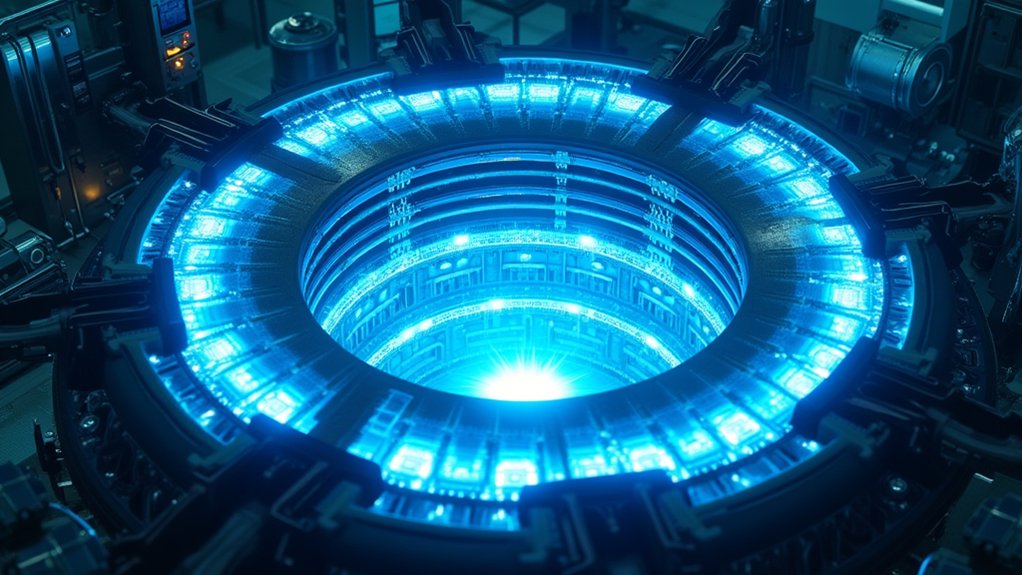
Located at the Institute of Plasma Physics in Hefei, EAST utilizes fully superconducting magnets to contain plasma that reaches temperatures exceeding 100 million degrees Celsius. The reactor’s water-cooled plasma-facing components and advanced diagnostic systems allow for precise manipulation of the superheated matter. I’ve observed few engineering feats that match this level of technical sophistication.
This achievement clears a major hurdle in fusion energy development. Maintaining stable plasma operation for over 1,000 seconds demonstrates significant advances in tokamak stability and heating efficiency. The breakthrough addresses critical challenges that have long plagued fusion research: temperature maintenance, stability control, and continuous operation.
EAST’s performance outstrips all competitors in the field of steady-state plasma confinement. While the U.S. National Ignition Facility has achieved net energy gain, it managed this only in brief bursts rather than sustained reactions. China’s leadership in long-duration plasma operation strengthens its position in global fusion research.
The implications for clean energy are substantial. Fusion promises nearly limitless power without greenhouse gas emissions or significant long-lived radioactive waste. The facility recently underwent significant improvements to its heating system, with power output doubled from 2023. This development accelerates prospects for addressing climate change through technology that effectively replicates the Sun’s power source here on Earth. The facility’s important role in the International Thermonuclear Experimental Reactor program highlights the global collaborative effort to advance fusion technology.
Challenges remain, of course. Commercial fusion reactors must maintain stability at high efficiency for far longer periods. The road from experimental success to practical electricity generation isn’t a straight line, but rather a series of increasingly difficult technical hurdles.
Nevertheless, EAST’s record-breaking run represents a critical step toward realizing functional, continuous fusion reactors that could transform global energy systems.