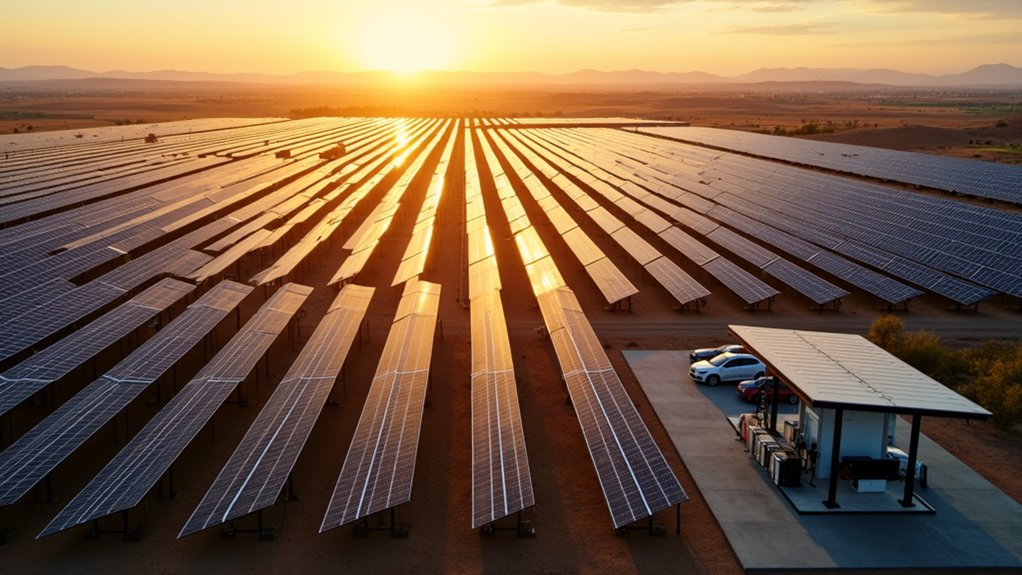

As renewable energy markets continue to shatter records worldwide, 2024 has emerged as a defining moment for the solar industry’s largest players. The sector has demonstrated remarkable resilience, with global installed capacity reaching an impressive 495 GWdc this year—a robust 14% year-over-year increase that signals accelerating adoption across diverse markets.
The American solar landscape is undergoing a transformative expansion, installing nearly 50 GWdc in 2024 alone. This 21% jump from previous year’s figures isn’t merely incremental growth; it represents a fundamental shift in energy infrastructure priorities.
America’s solar revolution isn’t just growing—it’s fundamentally reshaping our energy landscape with unprecedented momentum.
I’ve tracked utility-scale developments closely, and the projected capacity of 230.2 GW by 2025’s conclusion represents nothing short of a revolution in power generation paradigms.
Texas continues its remarkable solar journey, adding 13.6 GW to reach a cumulative 36.2 GW capacity, cementing its position as a renewable powerhouse with 16% of the national total.
Meanwhile, the Midwest region—once a minor player in solar development—is poised to increase its market share from 11% to 19% through aggressive expansion efforts totaling 21.4 GW.
Technology integration is rapidly maturing, with 9% of upcoming installations featuring co-located battery storage systems. Currently, 14% of operational U.S. capacity includes integrated storage, allowing for twilight power delivery that was once solar’s Achilles heel.
The Inflation Reduction Act continues catalyzing unprecedented capital flows into the sector, while improving supply chains have eased previous bottlenecks that hampered growth.
Corporate PPAs are reaching record volumes, creating stable revenue streams that make solar assets increasingly attractive to international investors seeking long-term returns.
The convergence of falling costs, technological advances, and supportive policy frameworks has created ideal conditions for established solar giants to capitalize on scale advantages.
As hybrid systems proliferate and grid integration technologies mature, 2025 stands poised to deliver the industry’s most consequential expansion yet, with major players perfectly positioned to capture disproportionate market share. Major manufacturers have established a consensus on minimum pricing, signaling a potential shift toward more stable market conditions that could benefit industry leaders.