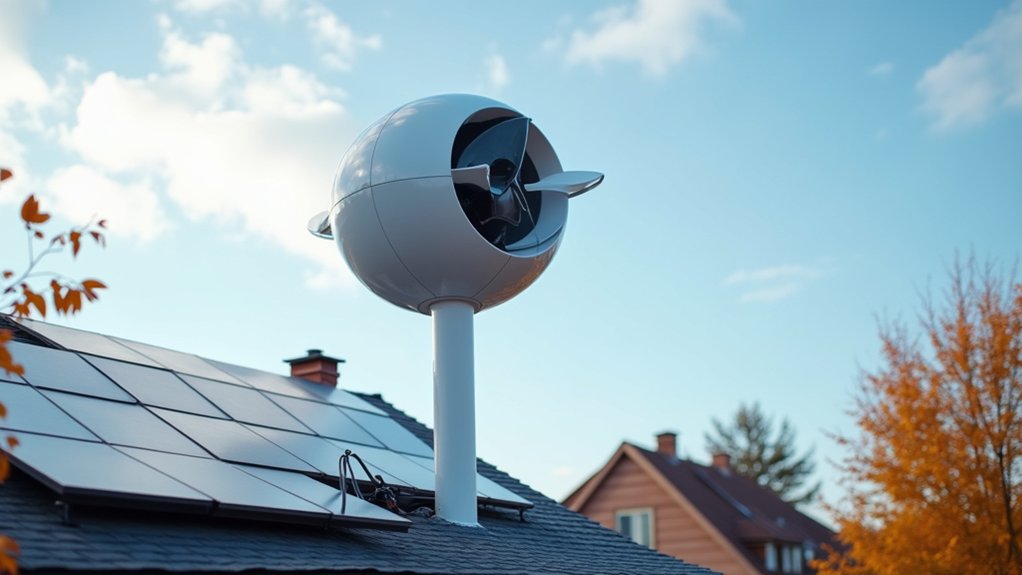
As renewable energy solutions continue to evolve, spherical wind turbines have emerged as a promising alternative for homeowners seeking to reduce their carbon footprint while maintaining energy independence. These innovative devices can generate energy equivalent to the average annual consumption of a standard UK household, rivaling the output of typical residential solar installations.
The omni-directional design of spherical turbines addresses a key limitation of traditional wind technology—directional dependency. By harnessing winds from multiple angles, these compact units maintain efficiency regardless of shifting urban airflows, a vital advantage in built environments where wind patterns are unpredictable.
Spherical turbines capture energy from all directions, solving the urban wind variability challenge that hampers conventional designs.
The integration of Venturi effect principles further enhances performance, allowing energy capture even at lower wind speeds that would stall conventional blades.
The aesthetic and practical considerations are equally compelling. Unlike their industrial-scale counterparts, spherical turbines present a sleek, unobtrusive profile suitable for urban integration. Their reduced noise emissions and bladeless design mitigate safety concerns for wildlife and residents, making them appropriate for dense residential settings.
I’ve observed that installation flexibility is another significant advantage, as units can be mounted on facades or rooftops without extensive structural modifications. As they feature a virtually silent operation, spherical wind turbines eliminate noise disturbances that might otherwise concern homeowners and neighbors. These turbines are constructed using recyclable composites, enhancing their environmental credentials beyond just clean energy generation.
What truly distinguishes spherical wind technology is its complementary relationship with existing renewable solutions. Unlike solar panels, which remain dormant during nighttime and produce diminished output in overcast conditions, spherical turbines can generate power continuously given appropriate wind conditions.
This operational continuity creates opportunities for balanced hybrid systems that compensate for seasonal or weather-related energy fluctuations.
The industry has taken notice of this potential, with designs like the O-Wind Turbine receiving prestigious recognition through the James Dyson Award for sustainable innovation.
As urban centers worldwide intensify decarbonization efforts, these compact energy generators represent a pragmatic pathway toward decentralized power production and enhanced grid resilience. For homeowners weighing renewable options, spherical turbines offer an increasingly viable alternative to traditional solar installations, particularly in regions with favorable wind patterns but limited consistent sunlight.