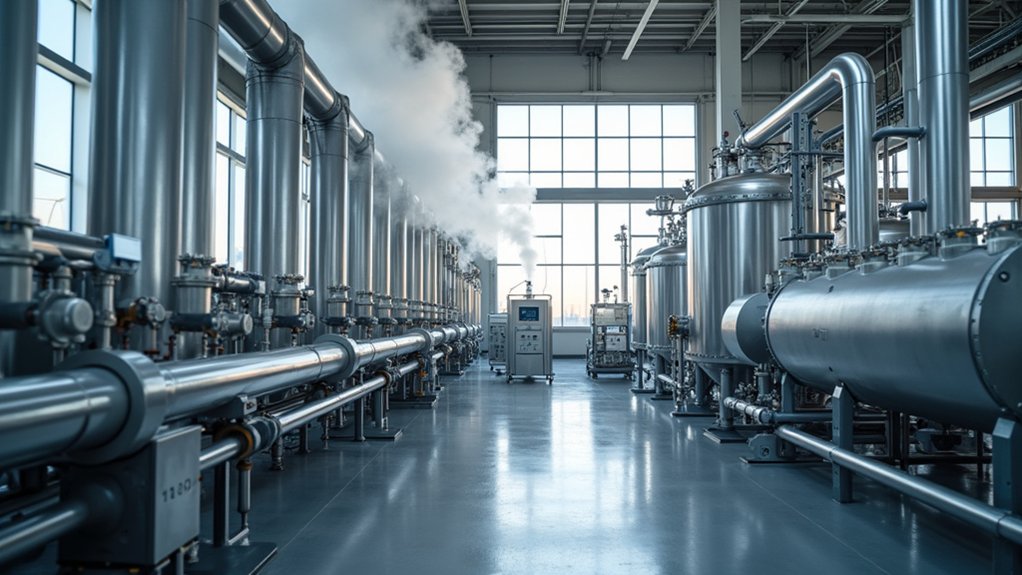

Innovation in industrial sterilization has taken a significant leap forward with the development of advanced clean steam technology. These systems generate saturated steam from purified water sources, maintaining strict contaminant-free conditions that have become essential in pharmaceutical manufacturing, healthcare settings, and precision cleanroom environments. The sophisticated engineering employs corrosion-resistant materials that prevent particulate shedding, chemical contamination, and microbial infiltration—critical factors in maintaining product integrity and compliance standards.
The environmental implications cannot be overstated. When examining the emissions profile, clean steam systems powered by renewable energy sources demonstrate remarkable reductions in greenhouse gas output compared to conventional fossil fuel alternatives. I’ve observed installations achieve up to 40% greater energy efficiency through optimized heat transfer dynamics and precision temperature control mechanisms. The inherent thermodynamic properties of water as a working medium, including its exceptional specific heat capacity, create a compelling case for conversion from oil-based thermal systems.
Contamination control represents perhaps the most significant advancement. Leaks in conventional steam infrastructure—traps, condensate returns, and feedwater tanks—introduce persistent contamination risks. The new systems incorporate failsafe sealing technology and automated condensate removal that virtually eliminates stagnation points where bacterial colonies typically flourish. Regular passivation cycles restore the critical passive layer of stainless steel components, ensuring long-term system integrity. Many systems utilize 316L stainless steel and other highly resistant materials to prevent rouging corrosion that can compromise steam quality.
Clean steam’s revolutionary sealing and condensate systems eliminate contamination hotspots where microbial threats once thrived.
Industrial applications continue to expand beyond traditional use cases. The ability to sanitize complex geometries without chemical agents has revolutionized manufacturing protocols in semiconductor fabrication, medical device assembly, and food processing lines. Modern systems feature adjustable steam pressure up to 85 PSI, allowing precise control for different cleaning requirements. The systems deliver consistent thermal profiles, reaching tight tolerances within ±0.5°C across treatment zones—performance that simply wasn’t possible with previous generation equipment.
The economic calculus increasingly favors clean steam adoption. Despite higher initial capital requirements, lifecycle cost analysis demonstrates superior returns through reduced maintenance requirements, enhanced production reliability, and diminished environmental compliance costs. The technology represents a rare win-win scenario: improved process outcomes with reduced environmental impact.