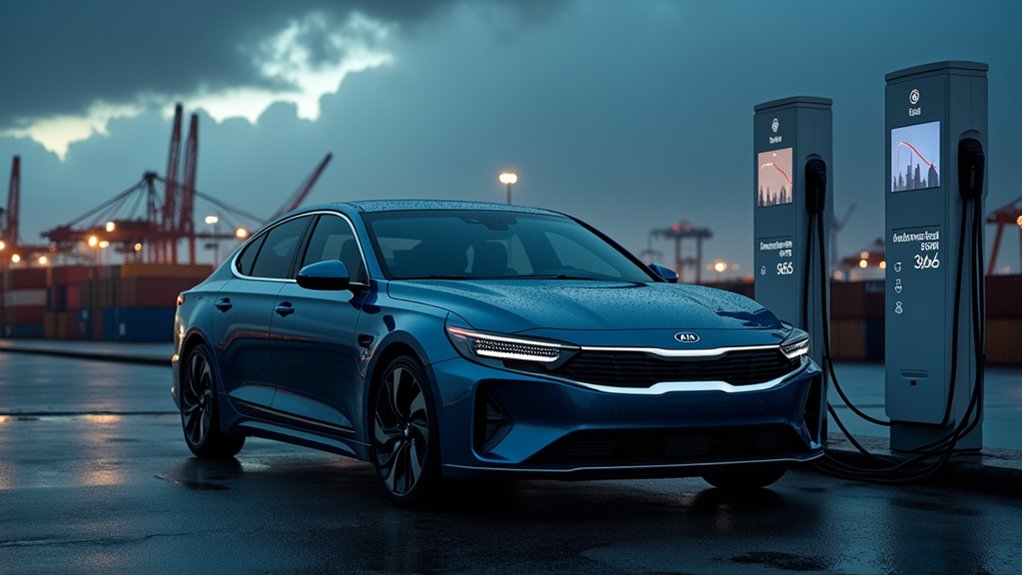

South Korean automaker Kia has scaled back its 2030 electric vehicle sales targets amid shifting market conditions, revising projections downward from 1.6 million to 1.259 million units. The adjustment reflects growing concerns about slowing EV demand and intensifying competition, particularly from Chinese manufacturers who continue to gain market share with aggressive pricing strategies.
The revised roadmap still maintains Kia’s ambitious overall sales target of 4.19 million vehicles globally by 2030, with environmentally friendly vehicles expected to constitute 56% of total sales. I’ve observed that Kia’s pragmatic approach acknowledges market realities while preserving their green shift timeline—a necessary calibration in today’s volatile automotive landscape.
Kia’s adjustment comes amid significant headwinds, including the European Union’s implementation of a 45% import tariff on Chinese EVs and political uncertainty following Donald Trump’s return to the U.S. presidency. These developments could potentially undermine EV-friendly policies that have bolstered adoption rates across North America, a key growth market for Kia. Despite the challenges, emerging U.S. adoption hotspots like New York and Florida could provide important growth opportunities for the automaker.
Despite these challenges, Kia has increased its five-year investment plan to 42 trillion won (2024-2029), with 19 trillion won earmarked for future businesses. The automaker will expand its environmentally friendly lineup from 23 models in 2025 to 32 by 2030, including 15 dedicated EV models. To adapt to changing market conditions, Kia is developing next-generation hybrid powertrains with improved performance and efficiency.
Hybrid vehicles, comprising 10 models targeting 993,000 annual sales by 2030, will play an increasingly significant role in Kia’s product portfolio. This hybrid-heavy strategy, I believe, offers a prudent hedge against unpredictable EV adoption rates.
Kia continues localizing production across major markets, manufacturing EVs at its Georgia facility for North American customers while expanding operations in Europe and China. The company’s president and CEO Kevin Ahn has emphasized that the focus is not on pushing volume to the market this year but rather on maintaining long-term goals despite short-term challenges. The company’s regional manufacturing approach mitigates exposure to potential trade barriers—an increasingly important consideration given the current geopolitical climate.
While Kia’s EV ambitions have been tempered, their commitment to electrification remains steadfast, with environmentally friendly vehicles projected to reach annual sales of 2.33 million units by 2030.