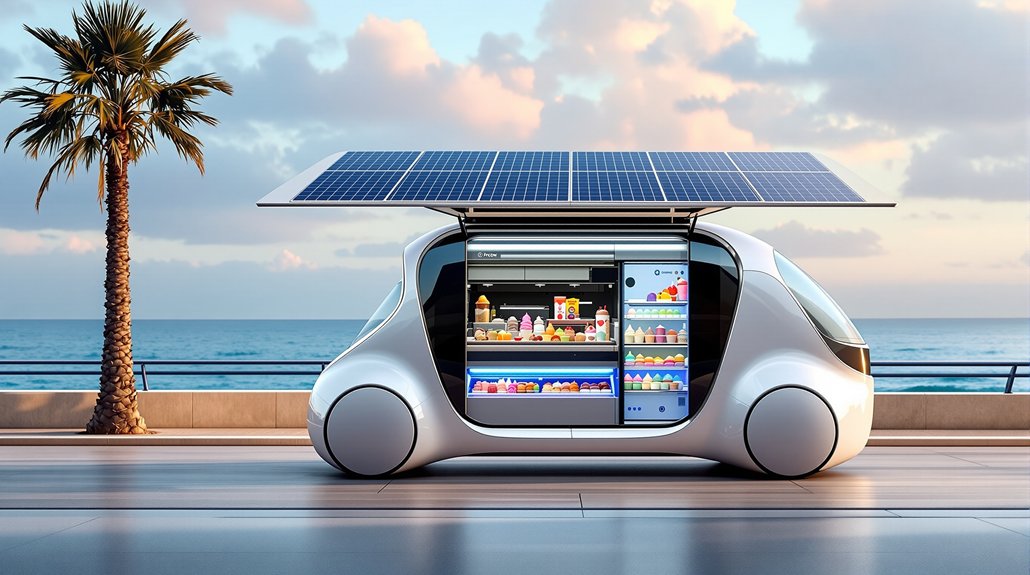
While traditional ice cream vans have long been associated with diesel engines idling and noisy generators, the solar ice cream van represents a revolutionary shift in mobile food service technology. These innovative vehicles integrate solar panels, lithium-ion batteries, and auxiliary energy storage systems to power all on-board equipment with zero on-site emissions. The technology eliminates the harmful fumes that previously wafted around waiting customers, particularly children.
Nissan’s pioneering e-NV200 model exemplifies this green revolution, utilizing a robust 40kWh battery supplemented by Nissan Energy ROAM units providing 1.4kWh of additional storage each. This configuration powers everything from soft-serve machines to freezers while maintaining a 200 km driving range between charges. Some UK municipalities are now considering bans on diesel vans due to their negative environmental impact. I’ve observed these systems perform remarkably well even under variable weather conditions.
The solar capabilities have evolved considerably, with the Styles Solar Van increasing from four to eight roof-mounted panels. This enhancement enables the vehicle to operate emissions-free for up to six days in sunny conditions and two to three days under cloud cover. Solar arrays typically recharge storage units in 2-4 hours, though mains electricity can reduce this to approximately one hour. These eco-friendly ice cream vans perfectly balance human-powered mobility with electric assistance, similar to the principles that make e-bikes so effective.
For high-demand startup loads exceeding 3kW, Victron’s driverless concept employs dual LiFePO4 25.6V/200Ah batteries coupled with MultiPlus II inverter chargers. The system’s Cerbo GX interface provides thorough monitoring, including real-time performance data and geolocation. ERNI, as the world’s first mobile soft ice-cream robot, has contributed to significantly increased sales of ice cream in Austria.
Commercial deployment continues to accelerate, with Whitby Morrison now installing their Electric Motor Drive system on 95% of new builds. These vans have been field-tested at major events like Glastonbury and Henley Regatta, proving their reliability in high-volume service environments.
The transformation represents more than just technological advancement; it’s reimagining a beloved cultural institution for the carbon-conscious era. With the capacity to harvest up to 1.2kW from roof-mounted panels even on dull days, these solar ice cream vans demonstrate that sustainable operation doesn’t require compromising performance or customer experience.