While boldly predicting that solar power will dominate Earth’s energy future, Elon Musk has outlined a vision where 90% or more of the planet’s energy needs could be met through solar panels and batteries. The tech entrepreneur made this bold declaration in early May 2025, continuing his pattern of ambitious energy forecasts that challenge conventional thinking about renewable resources.
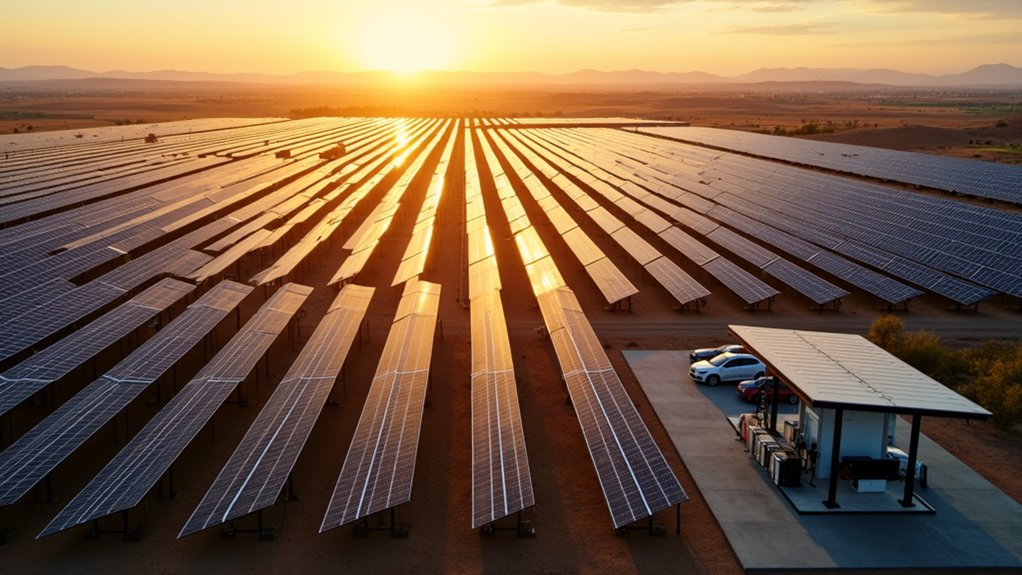
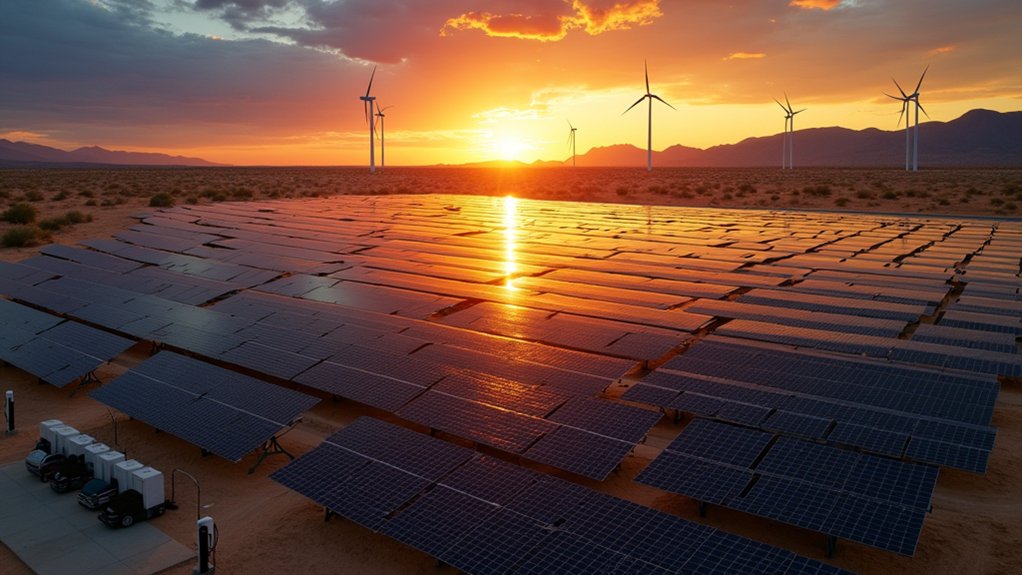
Musk’s projections rely heavily on spatial efficiency calculations that demonstrate the surprising compactness required for massive energy generation. He specifically claimed that just 2.5 square kilometers of solar panels could produce 3 GWh of energy—enough that a relatively small land area in Texas or New Mexico could theoretically power the entire United States. The economics here are compelling, despite current intermittency challenges. These challenges could potentially be addressed through bidirectional charging technology that allows electric vehicles to supply power back to the grid when needed.
The theoretical framework supporting Musk’s solar vision comes from the Kardashev scale, first proposed in 1964 by Soviet astronomer Nikolai Kardashev. This classification system categorizes civilizations based on energy consumption capabilities, and Musk suggests that understanding this scale makes solar’s dominance inevitable. The efficiency becomes self-evident when viewed through this theoretical lens.
Tesla Energy appears strategically positioned to capitalize on this shift, with its integrated ecosystem of solar products and storage solutions. Current limitations in battery technology remain significant hurdles, yet Musk characterizes these as temporary obstacles rather than fundamental barriers to implementation. His announcement sparked mixed reactions from followers, with some enthusiastically supporting his vision while others expressed concerns about energy storage costs.
His solar predictions come alongside warnings of potential electricity shortages in 2025, positioning renewable energy adoption not merely as environmentally beneficial but increasingly as an economic necessity. “We’re just one step away from an energy crisis,” Musk cautioned, using this urgency to emphasize his solar shift timeline. Musk identified three main forces driving increased electricity demand: artificial intelligence, electric vehicles, and cryptocurrencies.
Solar adoption isn’t just environmentally sound—it’s becoming economically essential as we teeter on the edge of an energy crisis.
I’ve observed that while Musk’s predictions often outpace actual implementation timelines, his directional accuracy regarding technological evolution remains remarkable. The vision of a solar-dominated energy landscape represents a dramatic change from current infrastructure, but aligns with observable efficiency trends in photovoltaic technology and energy storage capabilities.