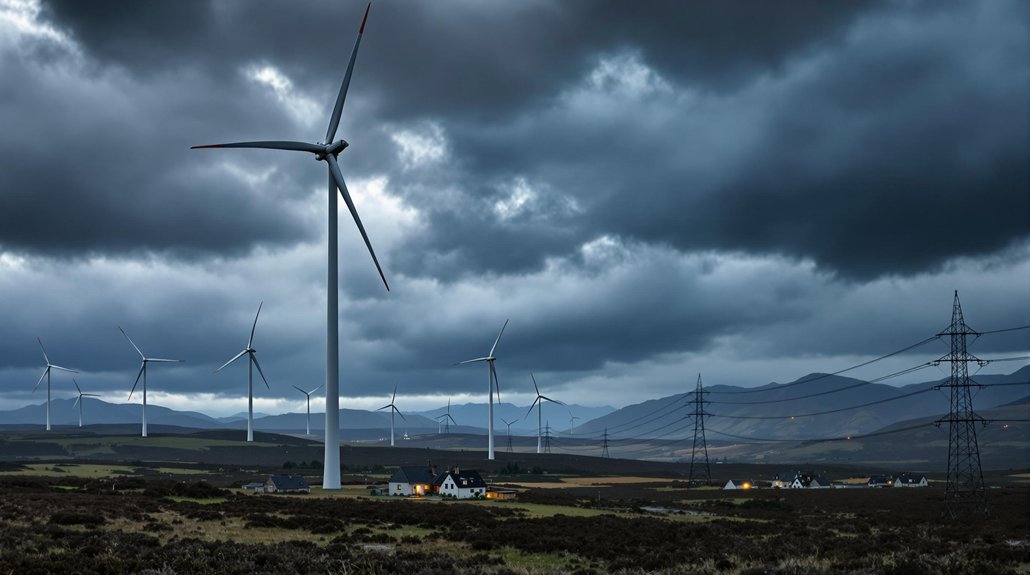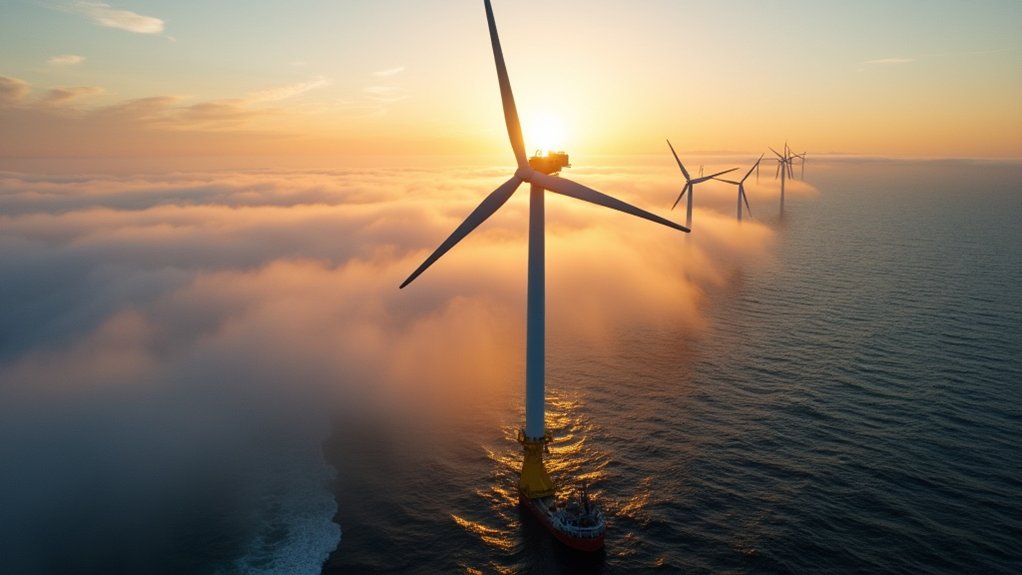
While renewable energy projects continue to expand globally, the Dogger Bank Wind Farm has set a new benchmark with its record-breaking turbines now operating in the North Sea. These engineering marvels stand 260 meters tall, nearly matching the height of New York’s Rockefeller Center, and dominate the seascape 130 kilometers off Yorkshire’s coast.
The turbines utilize GE’s Haliade-X platform, sporting truly massive dimensions. Each blade stretches 107 meters—longer than a standard soccer field—and when rotating, the 220-meter diameter sweep could encircle London’s iconic Eye observation wheel twice over. I’ve analyzed similar installations worldwide, and nothing approaches this scale of engineering achievement. The project represents a total investment of $10 billion across its three development phases.
Engineering on an unprecedented scale—blades longer than soccer fields, sweeping an area that dwarfs London’s iconic landmarks.
Power generation capabilities are equally impressive. The first commissioned turbine operates at 15 megawatts, with each complete rotation generating enough electricity to power a typical British home for two days. When fully operational in 2026, the 277 turbines will deliver 3.6 gigawatts, supplying approximately 5% of the UK’s total electricity demand and servicing 4.5 million households.
Installation required overcoming formidable challenges. The Voltaire, the world’s largest jack-up installation vessel, deployed 72-meter monopile foundations to anchor these behemoths against North Sea conditions. The construction team established new benchmarks for installation speed and efficiency, despite weather and supply chain obstacles.
The environmental impact of Dogger Bank cannot be overstated. These Haliade-X turbines produce 45% more energy than previous models, each generating up to 67 gigawatt-hours annually. This represents a substantial shift toward decarbonization in the UK’s energy portfolio. Similarly, the He Dreiht wind farm demonstrates remarkable efficiency with each turbine capable of powering a household for a full day with just a single rotation.
Occupying a seabed area roughly equivalent to Greater London, Dogger Bank will possess 2.5 times the capacity of today’s largest operational offshore wind farm. The project’s three-phase development will culminate in full commissioning by 2026, establishing it as the world’s most productive offshore wind installation and a cornerstone of Britain’s renewable energy strategy for decades to come.