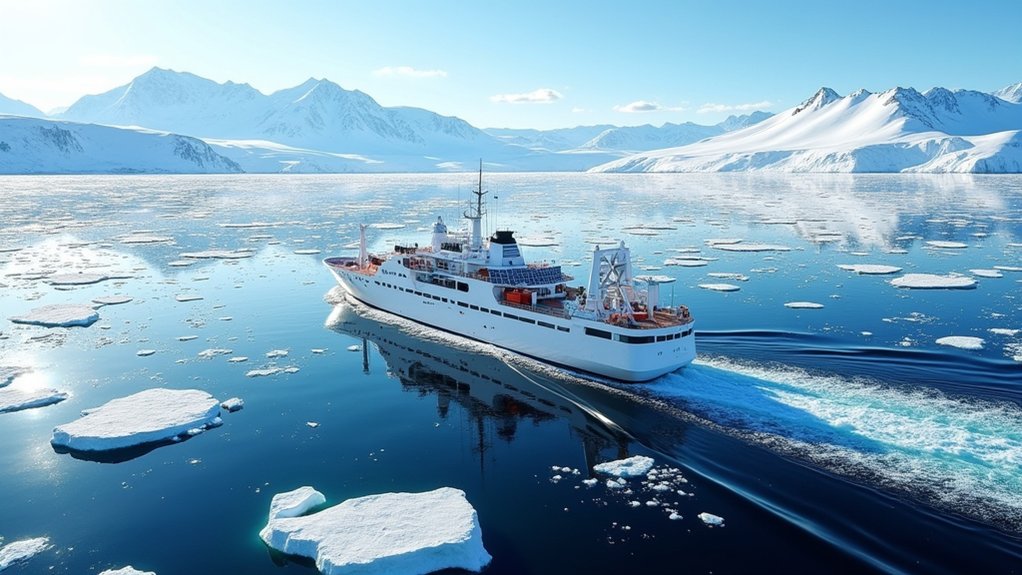
Dozens of scientific breakthroughs are emerging from China’s ambitious 41st Antarctic expedition, which launched in November 2024 with a formidable fleet of three vessels. The expedition, deploying research icebreakers Xuelong, Xuelong 2, and cargo ship Yongsheng, represents a significant expansion in China’s polar research capabilities. Scientists have completed the first active-source seismic exploration in inland Antarctic regions, advancing high-precision detection technology to internationally recognized standards.
China’s Antarctic ambitions flourish as three-vessel expedition delivers groundbreaking seismic research and expands polar capabilities.
The mission’s environmental research focuses on critical climate indicators through wideband hyperspectral microwave radiometers. These sophisticated instruments, operating like the advanced sensors in today’s hybrid vehicle systems, provide essential data on polar ice cap melting and subglacial water systems. In the Amundsen Sea, researchers extracted an 8.67-meter sediment core—a veritable time capsule of paleoenvironmental information that will help calibrate our understanding of ancient oceanic conditions.
China’s polar infrastructure continues to develop at an impressive pace. Construction of Qinling Station‘s supporting facilities remains a priority, establishing a robust platform for the nation’s expanding Antarctic presence. The strategic location of this station, completed in 2024, provides China with proximity to McMurdo and other key research facilities. The expedition facilitated a collaborative cruise in the Ross Sea region with multiple countries participating in groundbreaking research initiatives.
I’ve observed that the program’s technological achievements are particularly remarkable: the establishment of a Beidou Satellite Navigation System reference base station provides positioning precision comparable to high-end vehicle GPS systems.
The expedition represents more than pure science. China has mapped and surveyed over 300 Antarctic locations, compiled 400+ maps covering nearly 300,000 km², and developed a geodetic datum system for accurate regional mapping. These efforts parallel the nation’s growing influence in polar governance and policy development.
For the first time, Hong Kong scientists are participating in the expedition, which continues until May 2025. This collaboration mirrors China’s broader international engagement in Antarctic research.
The subglacial buoy design, optimized for harsh conditions, has achieved a record-setting 1,407 days of continuous data collection—reliability numbers that would impress even German automotive engineers. These advancements firmly establish China as a transformative force in Antarctica’s scientific frontier.