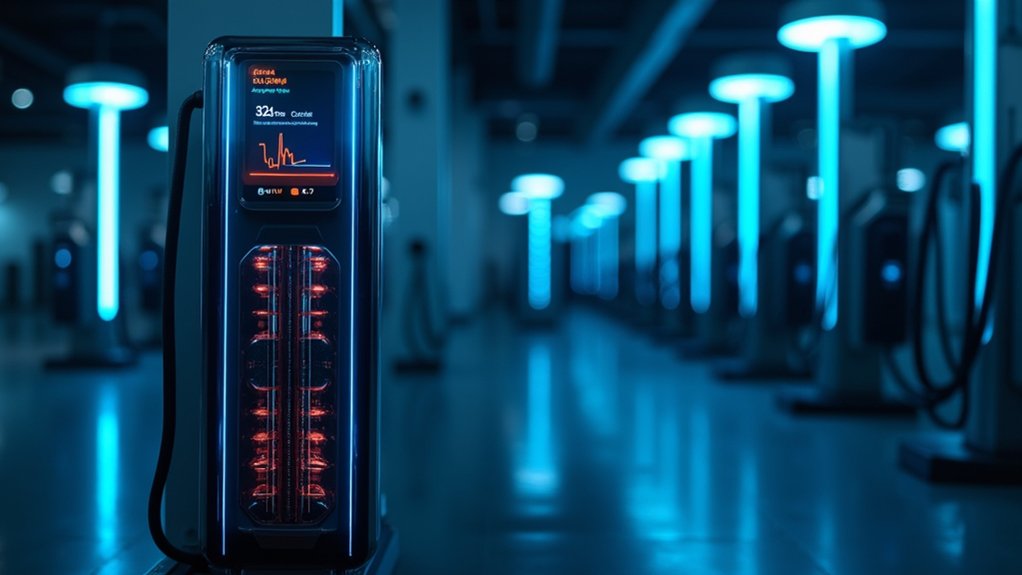

While the electric vehicle industry continues to evolve rapidly, CATL has established itself as a formidable leader in battery technology with innovations that noticeably outpace competitors. The company’s second-generation Shenxing batteries demonstrate unprecedented charging capabilities, adding 320 miles of range in just five minutes—a metric that surpasses both BYD’s offerings and even Tesla’s much-touted Supercharger network. I’ve seen few technological leaps so notable in the EV space.
CATL’s emphasis on energy density has yielded considerable dividends in vehicle range performance. Their dual-power batteries promise over 930 miles of driving range, effectively eliminating the range anxiety that has long plagued EV adoption. This achievement represents a 40-50% improvement over comparable BYD power cells, which typically prioritize thermal stability and cycle life over maximum range capabilities. Advanced thermal management systems help maintain optimal performance during the rapid charging cycles that CATL’s batteries are designed to handle.
CATL’s dual-power batteries shatter range limitations with 930+ miles—outpacing BYD by 40-50% and finally conquering EV range anxiety.
The introduction of sodium-ion battery technology further distinguishes CATL from market competitors. These batteries maintain high performance at temperatures as low as -40°C, a key advantage in cold-weather markets where lithium-ion alternatives struggle considerably. Their exceptional safety profile, demonstrated through rigorous physical stress testing with no thermal runaway events, positions them as the industry’s new safety benchmark. The ability to charge from 30% to 80% in just 30 minutes at -30C represents unprecedented cold-weather performance.
Production plans indicate mass manufacturing will commence in 2025, giving CATL first-mover advantage in this promising technology. The company has secured strategic partnerships with major automotive manufacturers, leveraging its technological superiority to expand market share against BYD’s more cost-focused approach. CATL continues to dominate with an impressive 36% market share in the global EV battery industry, more than double that of BYD.
The NCM chemistry employed by CATL delivers superior performance metrics compared to BYD’s LFP formulation, though at higher initial costs. This technological difference explains the performance gap between the two Chinese battery giants.
For consumers and manufacturers seeking maximum range and charging speed, CATL’s offerings clearly outperform the competition. Tesla, despite its vertical integration advantages, cannot currently match CATL’s charging speed accomplishments—a reality that’s reshaping competitive dynamics throughout the global EV ecosystem.