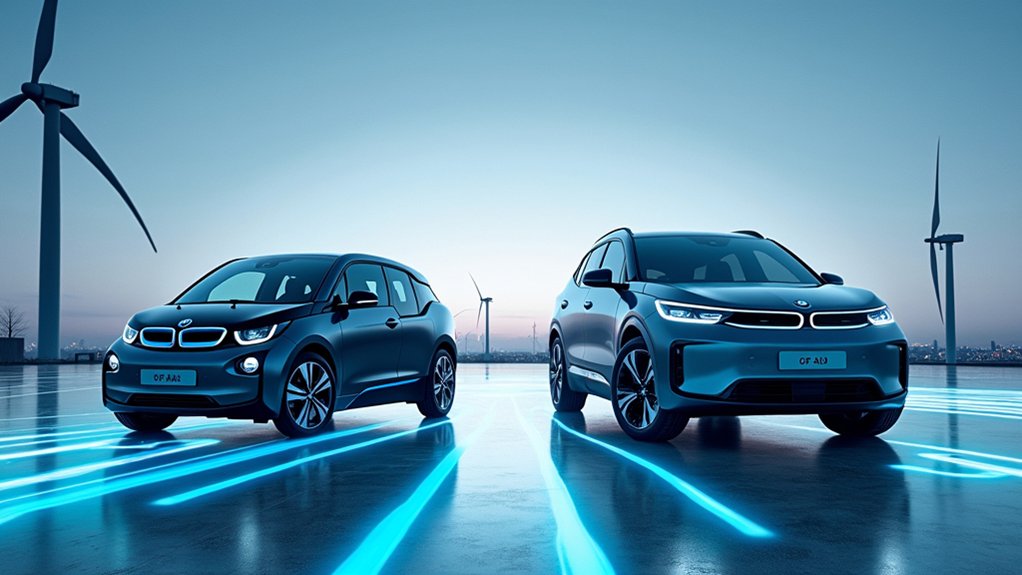
Few automotive manufacturers have pursued electric vehicle development with the persistence and methodical approach of BMW. The Bavarian automaker’s electrification journey began well before most competitors, with electric BMW prototypes appearing at the 1972 Munich Olympics. These early experiments established a foundation that would prove invaluable decades later.
Project 25, running from 1992 to 1996, deployed 25 electric 3 Series vehicles in real-world conditions, collecting vital data that informed subsequent development.
BMW’s Project 25 provided crucial real-world insights through electric 3 Series test vehicles, laying groundwork for future innovations.
The 2008 MINI E pilot represented BMW’s first large-scale electric experiment, with over 600 vehicles providing unprecedented insight into consumer charging patterns and usage habits. This was followed by the BMW Concept ActiveE in 2010, fundamentally a 1 Series Coupé converted to electric power. I’ve examined these prototypes firsthand, and their engineering sophistication was remarkable for the era.
The establishment of the BMW i sub-brand in 2011 marked the company’s commitment to purpose-built electric vehicles. Project i focused on developing lightweight, sustainable urban mobility solutions distinct from traditional BMW offerings. The prototype 1602 Electric offered a modest range of 37 miles that was competitive for its time. The culmination arrived in 2013 with the market introduction of the revolutionary BMW i3, featuring a carbon-fiber-reinforced plastic passenger cell and up to 153 miles of electric range.
The i3 was joined by the i8 plug-in hybrid sports car in 2014, a technological tour de force combining a 1.5-liter three-cylinder turbocharged engine with electric motors for exhilarating performance and 31 miles of electric range. In 2016, BMW announced the iPerformance model designation to highlight technology transfer from BMW i to their core brand vehicles.
Production of both models incorporated renewable energy at BMW’s Leipzig facility, underscoring the company’s holistic approach to sustainability. The company continues to navigate challenges around charging standardization that impact the overall EV ownership experience.
BMW’s electric portfolio has since expanded greatly, with the sophisticated i4 sedan delivering 301 miles of range and the flagship iX SUV showcasing the company’s latest technologies.
The company’s calculated strategy of offering both dedicated electric platforms and electrified versions of conventional models has positioned BMW uniquely among luxury automakers, allowing them to serve both EV enthusiasts and evolving buyers with equal expertise.