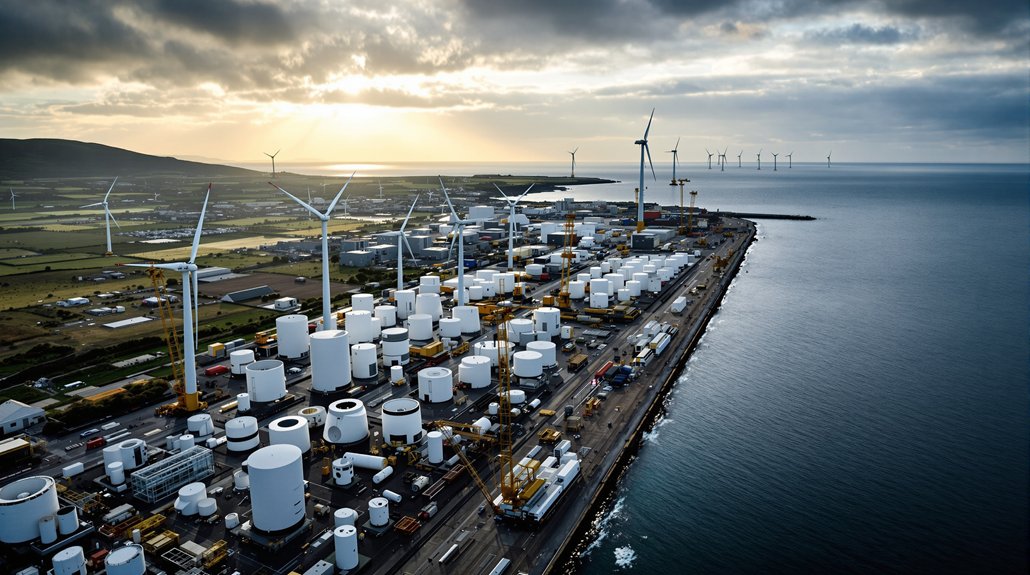

As global awareness regarding climate change continues to accelerate, the climate technology market is experiencing unprecedented growth across multiple sectors. Currently valued between $20.06-20.34 billion in 2023, this burgeoning industry shows remarkable potential with projections indicating a possible surge to $149 billion by 2032. The wide variance in growth forecasts—with CAGRs ranging from 10% to an ambitious 26%—reflects both opportunity and uncertainty inherent in this evolving landscape.
Environmental regulations and corporate sustainability commitments are driving significant investment momentum. The Paris Agreement and national net-zero targets have created a regulatory framework that virtually mandates adoption of climate technologies.
I’ve observed that consumer preferences are similarly shifting, with market demand increasingly favoring eco-friendly alternatives across the value chain.
Core technological innovations underpin this market expansion. IoT, analytics, and cloud computing form the technological backbone, while blockchain applications are rapidly gaining traction. Renewable energy sources—particularly wind, solar, and hydroelectric—continue their march toward cost parity with traditional sources. The integration of AI technologies offers substantial growth potential within multiple climate tech subsectors.
Smart grid technologies and energy storage solutions are finally overcoming efficiency hurdles that plagued earlier iterations.
Application diversity demonstrates the market’s expanding footprint. Carbon footprint management platforms, green building technologies, and water purification solutions address distinct climate challenges.
Carbon capture technologies and sustainable transportation systems represent high-growth segments attracting substantial investment capital. The electric mobility sector, currently valued at $71.5 billion, is significantly reshaping urban transportation through lower operating costs compared to conventional vehicles.
Despite promising growth trajectories, the sector faces considerable challenges. Third-party dependencies create vulnerability points throughout the supply chain. Climate-specific insurance solutions remain underdeveloped, creating exposure risks for early adopters.
The regulatory landscape, while driving adoption, creates a complex compliance burden that smaller players struggle to navigate.
The path to $149 billion won’t be linear. Technology cost curves must continue their downward trajectory, regulatory frameworks need harmonization, and third-party risk management protocols require substantial maturity.
Yet the market fundamentals remain compelling—climate tech isn’t merely emerging; it’s rapidly becoming essential infrastructure for a carbon-constrained world.
North America is positioned to maintain market dominance with its robust growth supported by U.S. policy initiatives aimed at reducing carbon emissions by 40% by 2050.