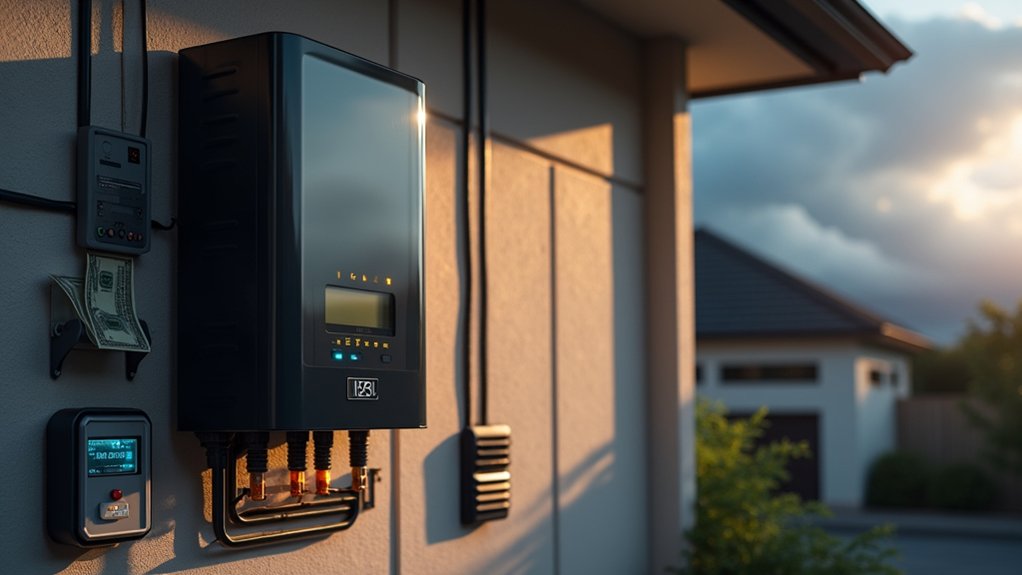

Nearly every homeowner considering residential energy storage faces a substantial investment decision, with solar battery installations commanding prices between $9,000 and $20,000 in today’s market. The pricing variability stems largely from battery chemistry choices, with lithium-ion systems typically ranging from $10,000 to $19,000, while more affordable lead-acid alternatives hover between $1,000 and $3,000. These figures represent base configurations; many installations require additional capacity for thorough home coverage. Among premium options, the Enphase IQ 10 consistently ranks among the most expensive at approximately $10,000 for a single unit.
The true cost equation extends beyond the battery units themselves. Critical load panels commonly add $1,000 to $2,000, while off-grid setups demand robust inverters and backup generators that drive totals higher. I’ve analyzed dozens of installations where permitting fees and regional labor rates created substantial price differences between otherwise identical systems. The financial calculus grows increasingly complex when factoring in integration with existing solar arrays.
Hidden costs lurk beyond battery hardware, with critical components and regional variables significantly impacting final installation expenses.
Government incentives provide meaningful offsets to these substantial costs. The federal investment tax credit currently offers a 30% reduction, translating to approximately $4,500 in savings for most installations. State-level programs, particularly California’s SGIP, further enhance the value proposition. Without these incentives, ROI timelines stretch considerably.
The savings side of the equation hinges on local utility rate structures. In regions with aggressive time-of-use pricing or frequent outages, batteries demonstrate clear value. A typical home requires around 11.4 kWh of battery storage to meet basic energy needs during outages. However, many installations struggle to achieve break-even periods under 10 years, especially when accounting for standby losses and conversion inefficiencies. Factor in the typical 10-year warranty period and subsequent replacement costs, and the financial case weakens further.
For many consumers, the battery decision transcends pure economics. The security of backup power during increasingly common grid disruptions represents an intangible benefit that’s difficult to monetize. This reliability premium, combined with the environmental benefits of optimized renewable energy usage, often tips the scales toward installation despite questionable financial returns.
Those seeking purely economic justification, however, should proceed with detailed analysis of their specific circumstances.