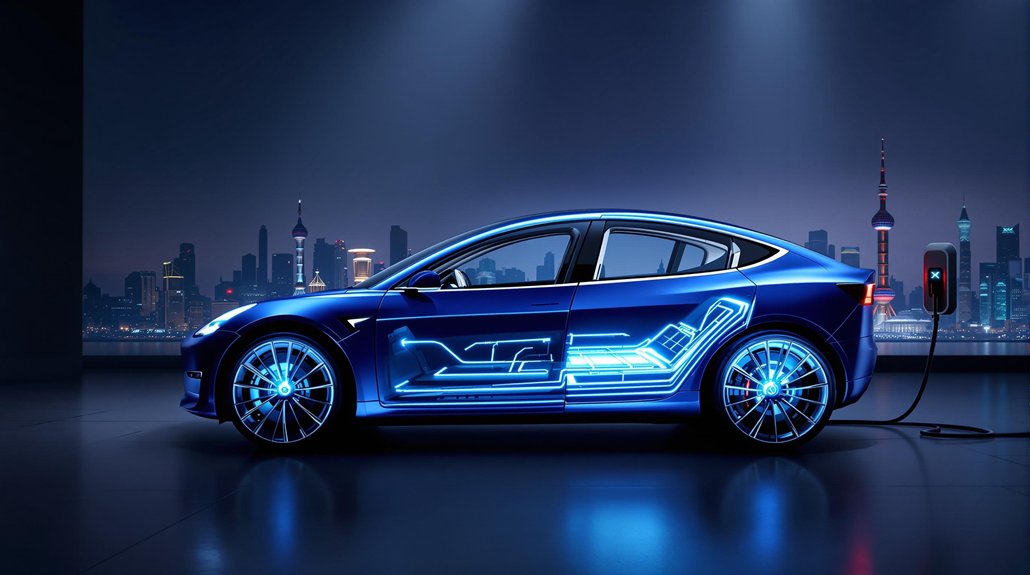
Significant battery improvements are coming to Tesla’s most popular vehicles for 2025, with both the Model 3 and Model Y receiving substantial upgrades to their power storage systems. The Long Range variants will now utilize 75 kWh battery packs employing NMC chemistry, known for its greater energy density, while Standard Range models will continue with the 60-62.5 kWh LFP packs that offer improved cycle life and durability.
These upgrades translate directly to impressive range increases. The Model Y Long Range now achieves between 586-622 km WLTP rating, solidifying its position among top performers in its segment. Even the base RWD variant sees its range climb to 593 km under the CLTC standard or 466 km WLTP—an improvement of 11-39 km over previous iterations.
Tesla’s range improvements continue to outpace the competition, with even the base models now delivering significantly enhanced travel distances.
I’ve noticed Tesla consistently delivers range improvements that outpace competitors’ iterative updates.
The charging infrastructure remains a key Tesla advantage. With 250 kW DC fast charging capacity, both models can complete a 10-80% charge in approximately 20-25 minutes. This positions them alongside premium competitors like the Porsche Macan while maintaining access to Tesla’s extensive Supercharger network. The upgraded vehicles will maintain compatibility with multiple charging standards globally, ensuring flexibility for owners traveling internationally.
Performance enhancements accompany the battery changes. The base RWD Model Y now features the ‘3D6’ electric motor delivering 220 kW, while the AWD variant combines two motors for a total output of 331 kW. Customers choosing the dual-motor configuration will benefit from improved ride comfort due to the retuned suspension. This results in improved acceleration, with the base RWD Model Y now reaching 100 km/h in just 5.9 seconds—a full second quicker than before. The Long Range AWD version offers even more impressive performance with 0-100 km/h in 4.6 seconds.
Tesla’s battery warranty remains competitive at 8 years or 120,000 miles, protecting against degradation below 70% capacity. The warranty transfers with ownership, adding to resale value.
Interior refinements complement these technical upgrades, with improved sound insulation creating a quieter cabin experience and electrically-folding rear seats enhancing practicality despite minimal cargo space reduction.
These updates reinforce Tesla’s market dominance, with the Model Y maintaining its position as the world’s best-selling electric vehicle while offering enhanced range, performance, and durability.