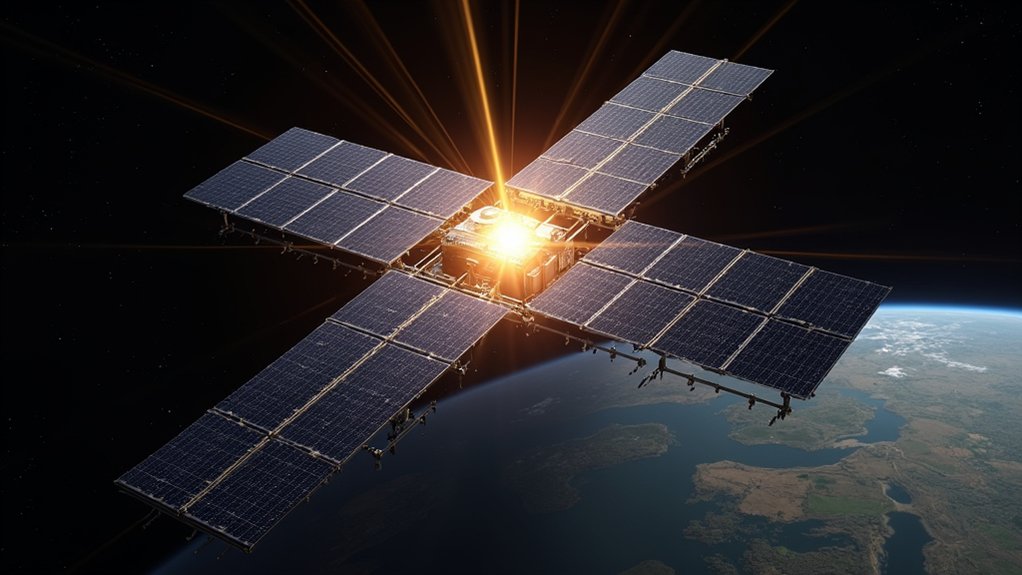

While terrestrial solar power continues to expand across global markets, scientists and engineers are setting their sights much higher—literally into Earth’s orbit. A UK-based firm has recently demonstrated a breakthrough technology capable of capturing solar energy in space at efficiencies up to 13 times greater than conventional Earth-based systems, potentially revolutionizing our renewable energy landscape.
The innovation leverages fundamental principles of Space-Based Solar Power (SBSP), which collects solar radiation without the limitations imposed by Earth’s atmosphere and day-night cycles. This approach isn’t theoretical—it requires no new physics breakthroughs, just engineering optimization and deployment logistics. The continuous collection capability means power generation 24/7, unlike ground installations that typically operate at 20-30% capacity due to weather and nighttime interruptions.
Their proprietary system employs lightweight reflectors and advanced photovoltaic arrays mounted on orbital platforms, capturing unfiltered solar energy before wirelessly transmitting it to Earth via microwave beams at specific frequencies. Reception occurs through ground-based rectennas that convert the microwave energy back into electricity for grid distribution. The system specifically utilizes the 2.45 GHz frequency for maximum transmission efficiency.
What’s particularly impressive about this UK development is the efficiency gains achieved through thermal management innovations. The concept builds upon decades of research that began when Peter Glaser patented microwave power transmission technology for space-based solar collection in 1973. Space structures don’t need to support themselves against gravity, allowing for more expansive and lighter collection arrays than anything deployable on Earth’s surface.
I’ve analyzed similar systems previously, and this implementation addresses several critical challenges that have historically limited SBSP adoption. The firm has reportedly reduced mass-per-watt metrics considerably, addressing one of the primary cost barriers to orbital deployment.
The environmental implications cannot be overstated. With fossil fuel reserves dwindling—oil and natural gas potentially exhausted within 50 years—this technology offers a genuinely sustainable alternative with minimal ecological footprint.
While space hazards like micrometeors remain concerns for any orbital infrastructure, the engineering team has incorporated redundant systems and protective measures to guarantee operational resilience. Their technology aligns with initiatives from NASA, ESA’s SOLARIS program, and Chinese space-based solar efforts, suggesting we’re witnessing the early stages of an orbital energy revolution.