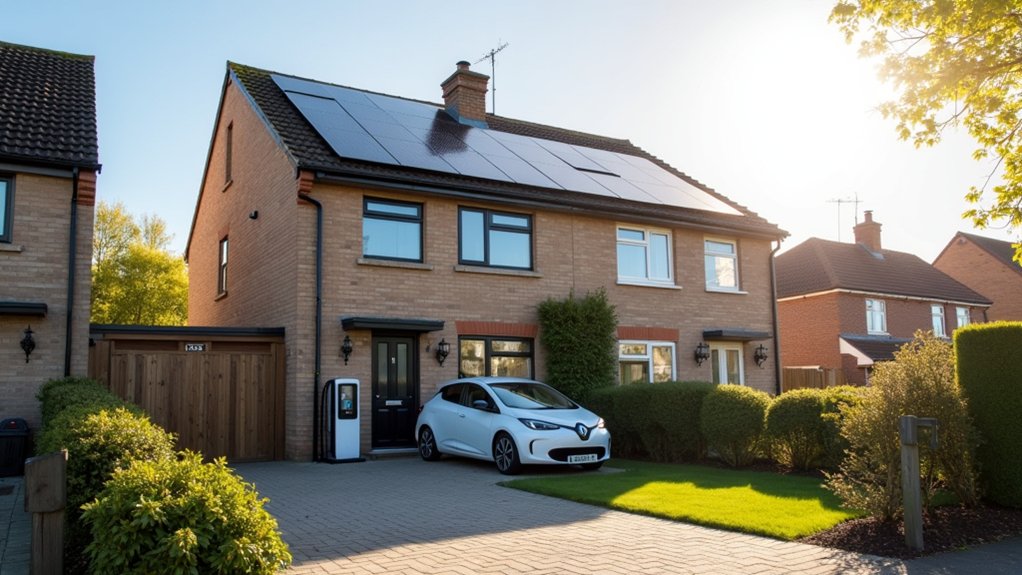

How exactly can UK homeowners access essential financial support for renewable energy installations? The landscape of solar funding has transformed dramatically, with schemes like ECO4 offering extensive support for panels, heating, and insulation—potentially slashing energy bills by over £1,000 annually. This represents a sea change in accessibility for average households.
The imminent launch of the Warm Homes: Local Grant in April 2025 marks a watershed moment for the sector. Running until 2028, this program specifically targets those most vulnerable to energy poverty: low-income households and social housing residents. Currently, only about 13% of UK households without solar panels are eligible for grants under existing programs.
The Warm Homes: Local Grant represents a critical lifeline for those trapped in the cold grip of energy poverty.
The complementary Warm Homes Plan, operational from January 2025, provides substantial funding up to £30,000, focusing heavily on solar implementation.
Financial incentives extend beyond installation costs. The Smart Export Guarantee replaced the outdated Feed-in Tariff, offering 1-5.5p per kWh for excess electricity fed back to the grid. When combined with the reduced 5% VAT rate on residential installations, the economic equation shifts dramatically in favor of adoption.
Eligibility criteria remain targeted but accessible. ECO4 and the Warm Homes grants prioritize fuel-poor households and properties with low energy ratings. I’ve observed that even landlords can now access SEG payments, provided installations meet building regulations—a clever policy adjustment that expands market potential.
The numbers tell a compelling story. With grants covering up to 75% of improvement costs (maximum £7,500-£9,000 per property), and potential annual savings exceeding £1,000, the ROI calculation has fundamentally changed. These figures don’t lie—solar adoption now represents a practical financial decision rather than an idealistic environmental choice.
The broader implications are significant. These programs directly support UK net zero targets while reducing household vulnerability to market energy fluctuations. The government’s ambitious goal to triple solar capacity by 2030 underscores the strategic importance of these initiatives.
The extensive technological scope—covering panels, batteries, heating systems and insulation—ensures holistic efficiency improvements rather than piecemeal upgrades. With certified installer requirements, quality standards remain high despite increased accessibility.