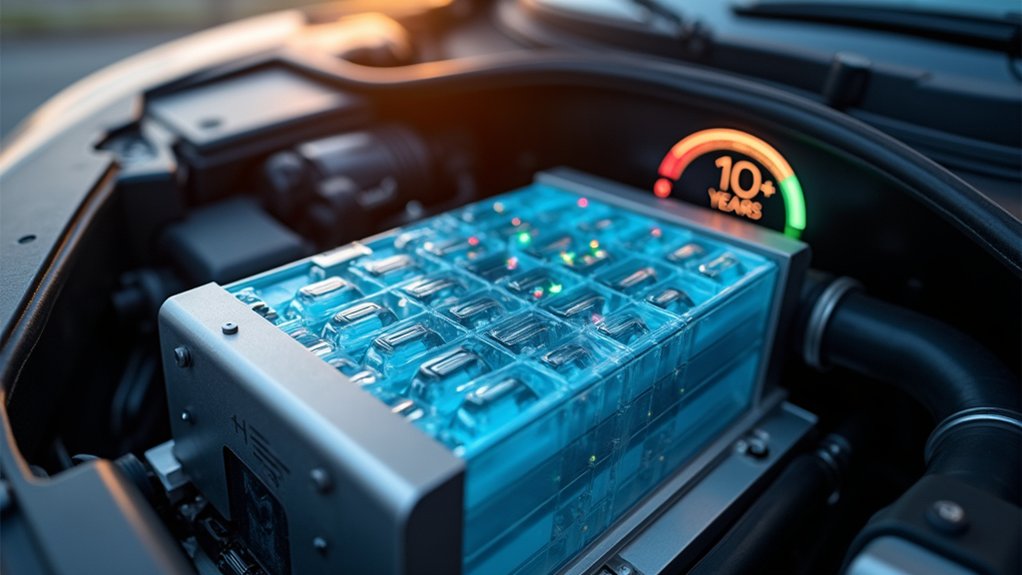

While plug-in hybrid vehicles continue gaining traction in today’s automotive landscape, understanding their battery technology remains essential for prospective buyers weighing long-term ownership costs. The reality is rather reassuring—PHEV batteries typically endure between 8 to 12 years or 100,000 to 150,000 miles under normal operating conditions. This longevity generally exceeds manufacturer warranties, providing reasonable value for the investment.
PHEV battery packs occupy the middle ground in the electrification spectrum, ranging from 8.0 to 18.0 kWh. They’re considerably larger than conventional hybrid batteries yet more modest than full EV powerplants. This strategic sizing helps minimize thermal stress while delivering sufficient all-electric range for daily commutes. The predominant lithium-ion chemistry, coupled with sophisticated cooling systems, offers impressive energy density and cycle life characteristics.
The degradation curve for these battery systems proves less aggressive than many consumers fear. With an average annual capacity loss of approximately 1.8%—slightly better than full EVs—owners can expect a 10-15% reduction in total capacity after 100,000 to 200,000 miles. This manifests primarily as diminished electric range and incrementally reduced fuel economy as the gasoline engine compensates more frequently.
PHEV batteries degrade gracefully, losing only 1.8% capacity annually—offering years of reliable performance before any noticeable range reduction occurs.
Environmental factors greatly influence battery health. Extreme temperatures, particularly prolonged heat exposure, accelerate capacity fade. Similarly, driving behavior matters; aggressive acceleration patterns and frequent deep discharges tax the battery considerably. I’ve observed that vehicles garaged in temperate environments consistently demonstrate superior battery retention rates. Manufacturers design their systems to use only a portion of capacity to prevent damaging discharge or overcharging events.
When batteries begin failing, the symptoms are unmistakable: shortened electric range, erratic state-of-charge readings, and illuminated warning indicators. The vehicle may reluctantly engage electric-only mode or exhibit inconsistent charging behavior. Yet these scenarios typically emerge well beyond the decade mark for properly maintained vehicles. The Battery Management System continuously monitors voltage and temperature to ensure optimal performance and prevent premature deterioration.
The automotive industry continues refining battery management systems to extend usefulness through sophisticated charge limiting protocols and thermal regulation. Most PHEVs utilize lithium-ion batteries that can withstand between 4,000 to 8,000 charge cycles before significant degradation occurs. For most consumers, PHEV batteries will reliably serve throughout their ownership period, making them a practical electrification stepping stone.