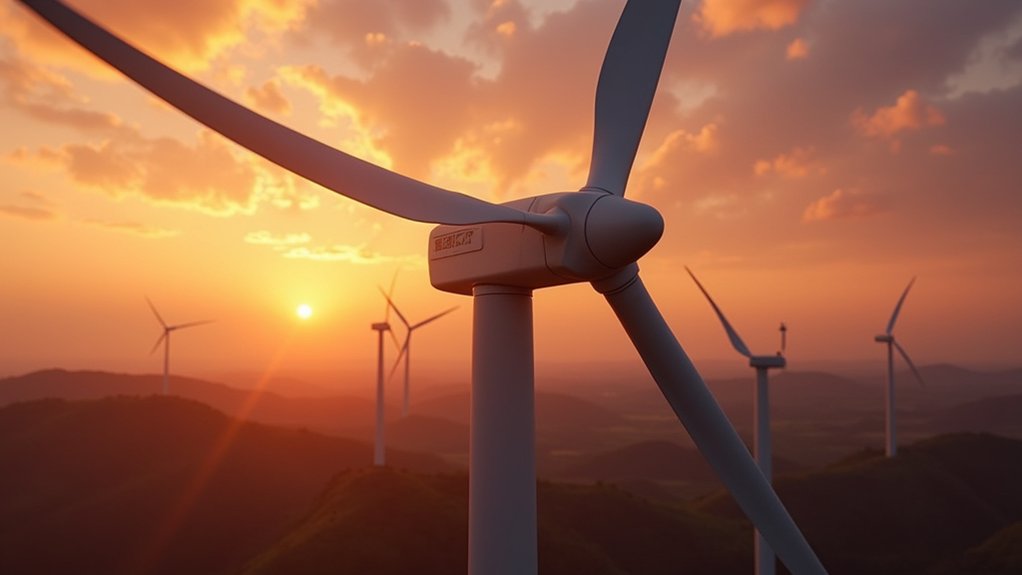

While conventional wind turbines have served the renewable energy sector admirably for decades, recent innovations in rotor blade technology are transforming the industry’s capacity for clean power generation. The evolution of bend-twist-coupled blades represents one of the most significant advancements, enabling blades to automatically adjust their angle of attack as they bend under load. This dynamic response, not unlike active suspension systems in performance vehicles, allows for longer blades without corresponding increases in weight or manufacturing costs.
Wind turbine blades that think for themselves—engineering elegance that flexes intelligently with the changing winds.
Flatback airfoils have revolutionized the structural integrity equation. These designs maintain constant thickness throughout the main structure, simplifying production while enhancing aerodynamic efficiency by 7-12% compared to conventional profiles. The hybrid approach—flatbacks for inner segments, thin airfoils for outer portions—optimizes the entire blade span for maximum energy capture.
Advanced composite materials now dominate blade construction, with carbon fiber reducing weight by up to 30% while improving tensile strength. The metallurgical principles behind these composites mirror those used in Formula 1 monocoques, creating structures that are simultaneously lightweight and exceptionally durable. These advances in materials have contributed to the 60% cost reduction in wind power from 2011 to 2021, making renewable energy increasingly competitive with conventional sources.
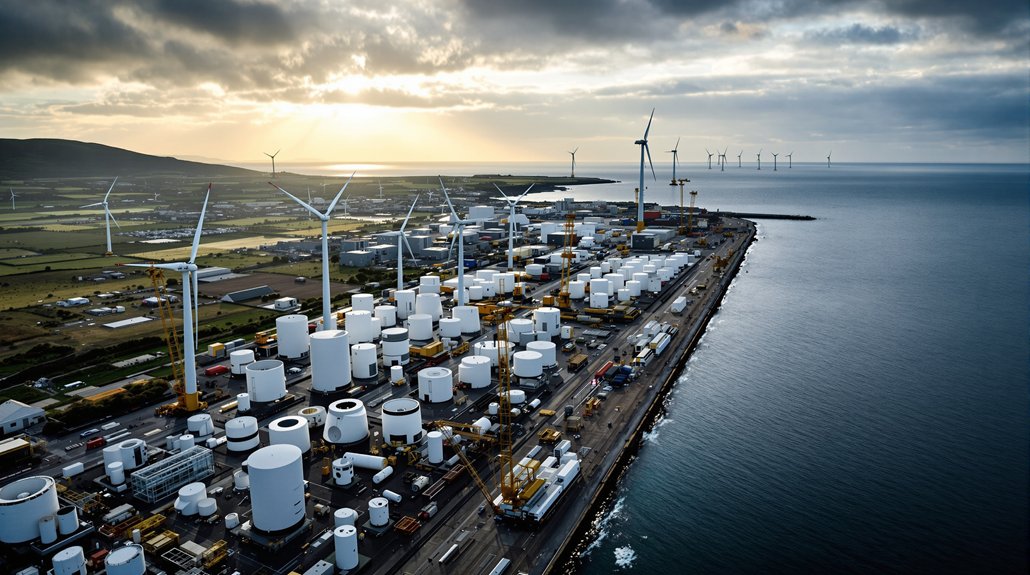
The logistics challenge of transporting 80+ meter blades has spurred innovation in segmented construction. These modular designs allow transportation through challenging terrain that would otherwise prohibit installation of large-scale turbines. Field assembly techniques have advanced to guarantee structural integrity comparable to single-piece designs.
Rotor geometry optimization continues to yield impressive gains. Engineers have fine-tuned blade width, length, and coning angles to maximize the lift coefficient throughout the blade span. These refinements often deliver 3-5% efficiency improvements with no additional material costs—the aerodynamic equivalent of free horsepower.
Upscaling remains the industry’s North Star, with each meter of additional blade length capturing approximately 2% more energy. Novel joint designs and smart materials that respond dynamically to wind conditions point toward a future of ultra-efficient turbines capable of generating power at wind speeds as low as 3 meters per second. The synergy of bend-twist coupling and flatback airfoil technologies has contributed to an estimated 20% reduction in overall energy costs.
The humble turbine blade has quietly become a marvel of modern engineering.