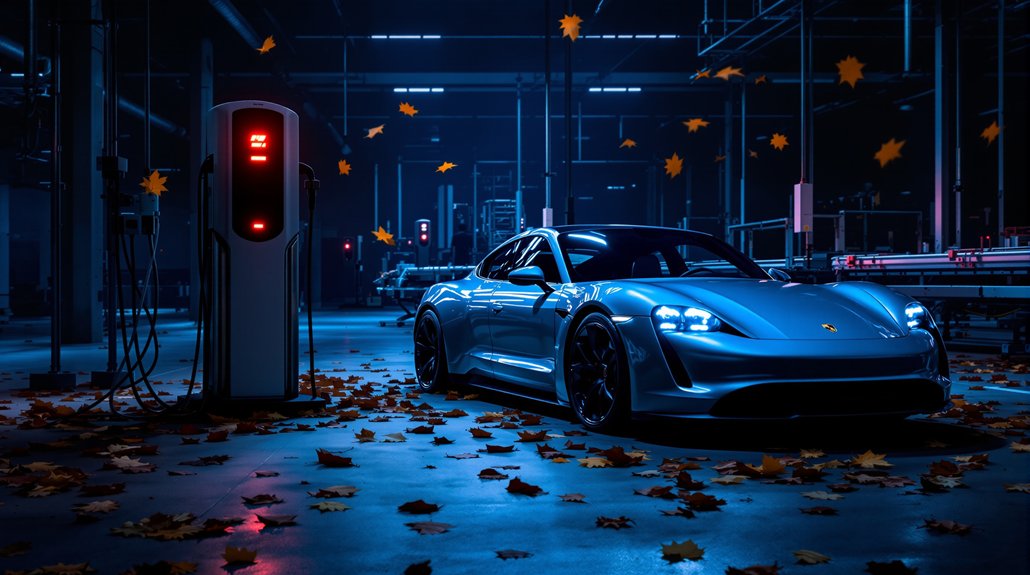
Numerous challenges have forced Porsche to delay its electric vehicle rollout, sending shockwaves through the automotive industry. The luxury automaker announced a significant pushback of selected all-electric vehicle launches, causing immediate financial repercussions as shares plummeted 7.5% following the announcement. The delay reflects mounting pressures in Porsche’s key markets, particularly China and the United States, where luxury EV demand has failed to meet projections.
The financial impact has been swift and severe. Porsche’s profits were nearly wiped out in Q2 2025, prompting the company to slash its 2025 margin outlook to a mere 2%, down dramatically from previous guidance of 5-7%. Operating profit is expected to take a hit of up to €1.8 billion ($2.1 billion). The extraordinary expenses of 3.1 billion euros anticipated for the 2025 financial year further illustrate the substantial cost of this strategic realignment. These adjustments send a clear signal that the shift to electric mobility faces more obstacles than many manufacturers anticipated.
Porsche’s financials tell a sobering story: profits evaporated, margins slashed, and a multi-billion euro hit to operating profit.
Parent company Volkswagen bears significant exposure to these setbacks, owning 75.4% of Porsche. The EV delay prompted Volkswagen to cut its own profit forecast by $6 billion and reduce its overall margin outlook to 2-3% for 2025. This comes at a critical time when global EV sales are projected to reach 17 million units by 2024. An anticipated €5.1 billion charge will further impact Volkswagen’s bottom line. Porsche SE, as largest shareholder of Volkswagen, has also issued a profit downgrade in response to these developments.
Market conditions tell a compelling story. Increasing international tariffs, especially in the U.S., combined with China’s economic slowdown have created a perfect storm for luxury EV makers. Competition from local players and insufficient charging infrastructure have further dampened consumer enthusiasm.
Porsche’s strategic realignment includes retaining hybrids and combustion engines through the 2030s, prioritizing flexibility over aggressive electrification timelines. This pragmatic approach acknowledges market realities while preserving brand identity.
The delays create potential gaps in Porsche’s product pipeline and raise questions about the company’s innovation trajectory. For a brand built on performance leadership, these setbacks could challenge its technological reputation. Yet the move might ultimately prove prudent if it allows Porsche to navigate the challenging shift while maintaining profitability and brand integrity.