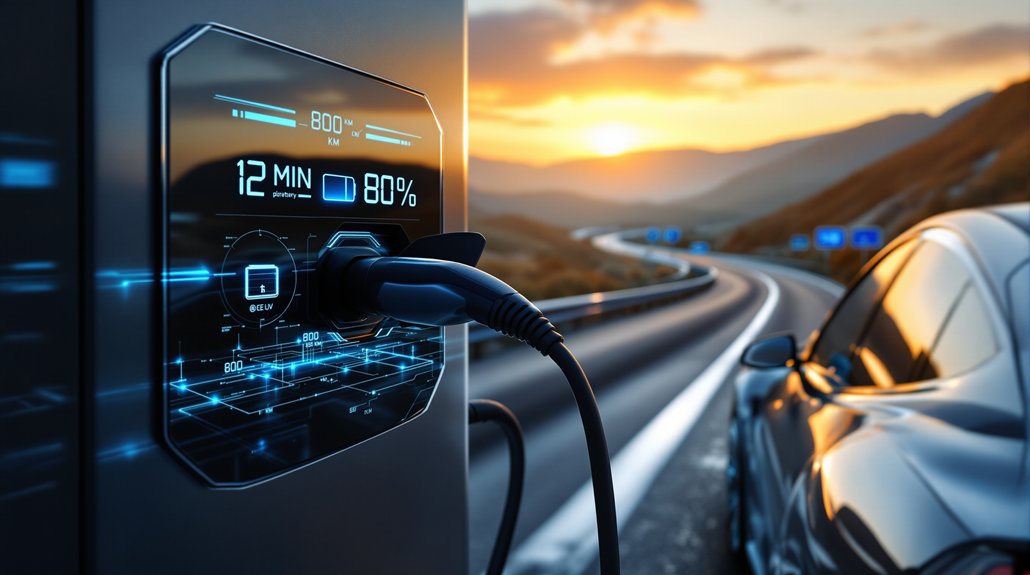

Several revolutionary EV battery technologies are finally delivering on the long-promised vision of ultra-fast charging without compromising range or longevity. New lithium-based chemistries can now charge from 5% to 70% in just 12 minutes, transforming how consumers view electric vehicles. CATL’s production-ready Shenxing Pro battery demonstrates this remarkable capability in real-world applications, achieving 10% to 80% charge in the same timeframe—a breakthrough that’s already reaching consumers in vehicles like the Xpeng G9.
The EV revolution arrives with batteries that charge in minutes without sacrificing range—a game-changer for electric mobility.
These advancements stem from significant innovations in battery chemistry. Lithium-metal batteries replace conventional graphite anodes, while lithium-sulfur variants offer up to 10 times the energy density of traditional cells. The engineering challenge of dendrite formation, which previously plagued fast-charging batteries, has been largely overcome through advanced liquid electrolytes specifically designed to suppress unwanted crystal growth during charge cycles. Korean researchers have developed a new liquid electrolyte that ensures even ion deposition on the anode surface.
Range anxiety, long the Achilles’ heel of EVs, appears headed for extinction. Laboratory and real-world testing confirms these next-generation batteries can power vehicles for up to 500 miles (800 km) on a single charge. I’ve examined the data from multiple manufacturers, and the consistency is impressive—these aren’t just theoretical maximums but achievable targets in production vehicles. These batteries operate within an optimal voltage range of 300 to 800 volts, allowing for efficient power delivery while maintaining thermal stability.
Perhaps most remarkable is that these performance improvements don’t sacrifice longevity. CATL’s commercial LFP cells target an astonishing 600,000-mile lifespan, making battery replacement a distant concern for most owners. Testing shows consistent fast-charging capability maintained over hundreds of cycles with minimal capacity degradation. The safety profile of these batteries is also significantly improved, with lithium-sulfur technology offering improved safety features compared to conventional lithium-ion systems.
Challenges remain, particularly for lithium-sulfur technology, where cathode expansion and the “shuttle effect” reduce efficiency. Infrastructure must also evolve to deliver the 313 kW (and potentially up to 660 kW) charging rates these batteries can accept.
The confluence of rapid charging, extended range, and impressive durability represents a genuine inflection point for electric mobility. When charging takes barely longer than filling a gas tank while delivering 800 km of range, the last meaningful objections to EV adoption begin to evaporate.