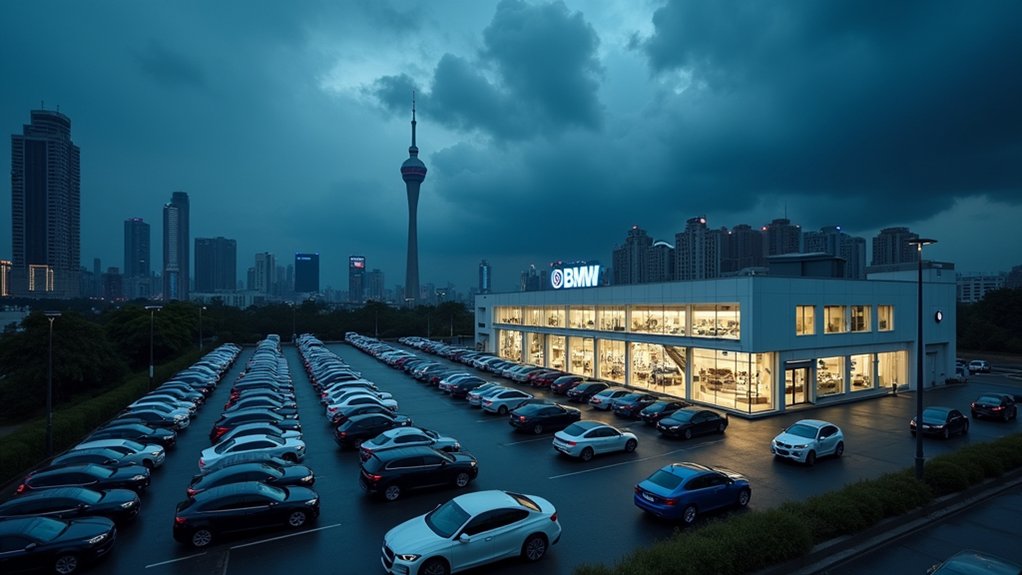
While global automakers face varying challenges in international markets, BMW has encountered a particularly steep decline in China, with first-quarter sales plummeting 17.2% to their lowest level in five years. The luxury automaker’s performance in the world’s largest automotive market signals deeper issues beyond seasonal fluctuations, with economic slowdown and intense local competition transforming the landscape.
The sales crash in China has dragged down BMW Group’s global performance, which fell 1.4% year-over-year in Q1 2025 to 586,149 vehicles. The core BMW brand specifically suffered a 2% decline to 520,142 units. China’s status as the largest market for BMW continues to create significant vulnerability for the company’s global strategy. This contrasts sharply with the company’s electric vehicle segment, which saw impressive growth of 28.5% globally during the same period.
China’s economic challenges provide significant context for BMW’s struggles. A sluggish economy coupled with a declining property market has undermined consumer confidence, making luxury car purchases increasingly difficult to justify. Government incentives have proven insufficient to stimulate spending in the premium vehicle segment.
The faltering Chinese economy has left luxury automakers like BMW stranded in a market where premium purchases have become increasingly unjustifiable.
Technical difficulties have compounded BMW’s market challenges. The integrated braking system (IBS) issues affected approximately 1.5 million cars globally, delaying Chinese deliveries of 320,000 units. These quality concerns have damaged both sales potential and brand reputation in a highly competitive environment.
Chinese manufacturers have capitalized on BMW’s vulnerabilities. Local brands like BYD offer competitively priced alternatives that increasingly match premium features at more accessible price points. BMW now struggles against more than 90 EV brands dominating the domestic market with innovative, budget-friendly options. Proposed tariffs by President Trump could further complicate BMW’s position in the highly competitive market.
The trend extends beyond BMW, affecting the entire premium segment. Mercedes-Benz reported a 7% sales decline in China, with flagship models like the S-Class dropping 10%. Similarly, Volkswagen experienced a 7.1% decrease in Chinese sales during the same period.
BMW’s positive sales growth in the Americas (up 5.4%) and momentum in Germany offer some consolation, but the company’s recovery trajectory remains heavily dependent on addressing its challenges in China, where shifting consumer preferences and economic headwinds continue to reshape market dynamics.