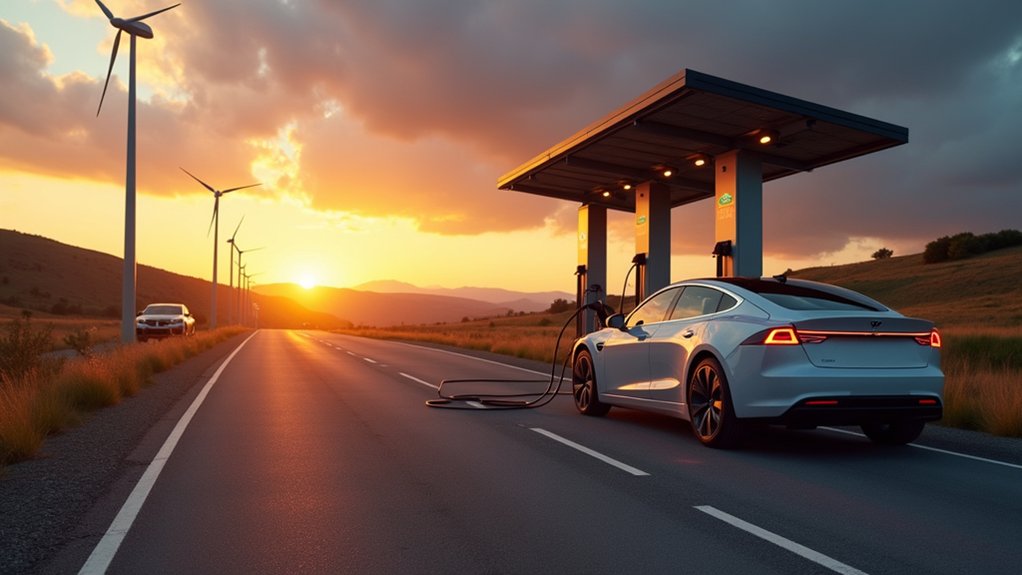
While the automotive industry undergoes its most significant evolution since the Model T rolled off assembly lines, electric vehicles have emerged as a pivotal technology in the battle against climate pollution. These zero-emission vehicles eliminate tailpipe emissions entirely, offering an immediate reduction in carbon output compared to their internal combustion counterparts. The data demonstrates that even accounting for emissions from electricity generation, EVs maintain a substantially smaller carbon footprint throughout their lifecycle. PHEVs can operate in all-electric mode with zero direct emissions, representing an important transitional technology in the electrification landscape. Electric vehicles convert most of their energy directly into motion, achieving much higher efficiency than conventional vehicles that waste approximately 75% of fuel energy as heat.
The potential climate impact is remarkable. Research indicates that if EVs reached just 25% market penetration in the United States, we’d see an annual reduction of 242 million tons of CO2 emissions—even with our current electricity grid. I’ve examined multiple studies confirming these findings, which consistently show that EVs deliver environmental benefits regardless of regional power sources.
Electric vehicles: climate impact at scale with just 25% adoption eliminating 242 million tons of CO2 annually.
Beyond carbon reduction, the air quality improvements are substantial. For every increment of 20 zero-emission vehicles per 1,000 residents, communities experience a 3.2% decrease in asthma-related emergency visits. The health implications are profound: a 25% EV adoption rate would prevent 437 deaths annually from particulate matter reduction alone, with another 98 deaths avoided through decreased ozone formation.
The economic case is equally compelling. Health cost savings reach $16.8 billion annually at 25% market penetration, potentially escalating to $70 billion if adoption hits 75% alongside clean energy integration. Advanced battery management systems ensure optimal performance and longevity while maximizing the environmental benefits of electric vehicles. Smart policy frameworks that synchronize transportation electrification with renewable energy expansion multiply these benefits exponentially.
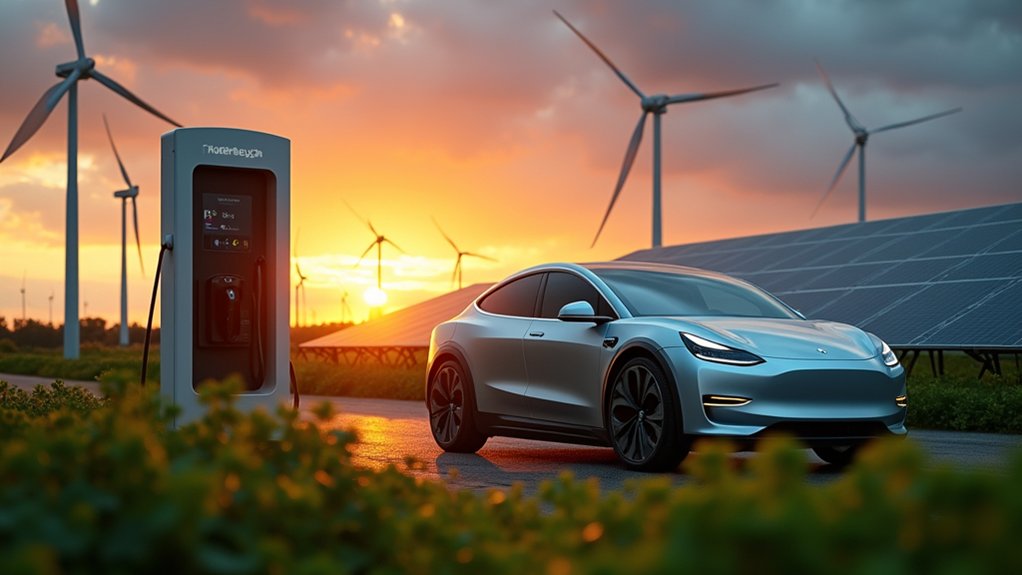
Charging infrastructure and grid modernization represent the critical link between EVs and their full climate potential. Regions evolving to renewables will see amplified benefits from electrified transportation. The synergy between decarbonized electricity and EV adoption creates a powerful mechanism for emissions reduction that could outpace current climate projections.
The evidence is clear—electric vehicles aren’t merely an alternative transportation option but a transformative climate solution capable of delivering environmental, health, and economic benefits far sooner than conventional wisdom suggests.