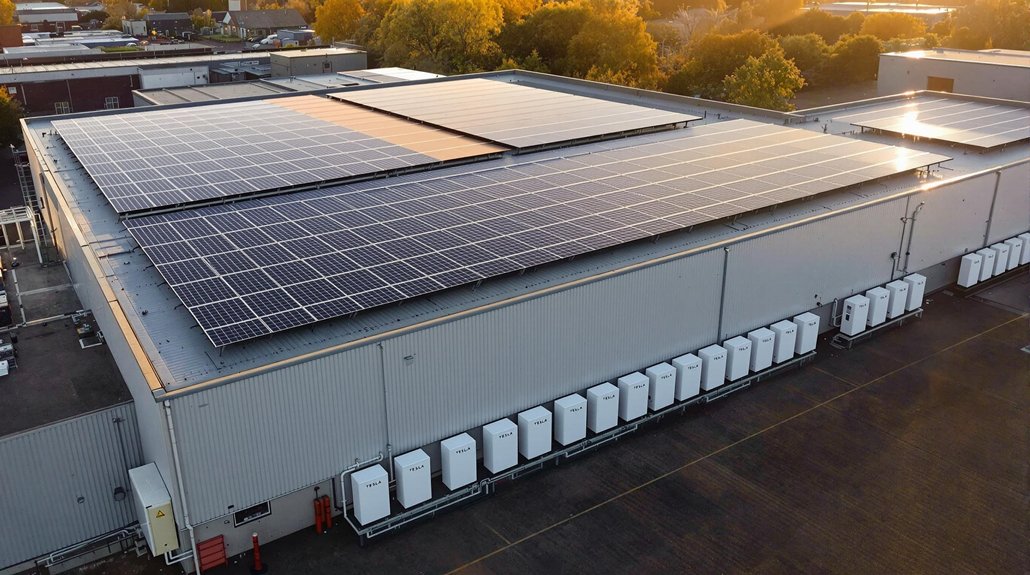

A groundbreaking energy installation has emerged at Portsmouth’s Hilsea Industrial Estate, marking the UK’s largest operational Tesla Powerwall deployment to date. The system integrates ten Powerwall units delivering approximately 135 kWh of storage capacity, paired with an expanded 250 kW rooftop solar array comprising 738 panels. This notable upgrade from the site’s initial 50 kW solar installation completed in 2016 represents a major advancement in municipal energy infrastructure.
The Portsmouth City Council-owned facility has achieved remarkable grid independence, reducing reliance on utility power by nearly 50%. The sophisticated control system orchestrates charging during daylight hours from excess solar generation and during off-peak nighttime periods, then strategically discharges stored energy during peak demand windows. During summer months, the installation is expected to supply most of the industrial estate’s electricity requirements through on-site generation and storage.
Carbon reduction figures are particularly impressive, with projected annual emissions savings of 69 tonnes CO2e. The system’s efficiency is enhanced through elimination of transmission losses typically associated with grid-delivered electricity. The project directly supports Portsmouth City Council’s net zero carbon target by 2030. The stored energy has sufficient capacity to power average domestic homes for approximately two weeks. I’ve analyzed similar installations, and this configuration’s load-shifting capabilities substantially contribute to lower-carbon consumption patterns.
The Hilsea installation eliminates transmission losses and shifts load patterns, delivering impressive carbon reductions of 69 tonnes annually.
The economic case appears equally compelling. The battery storage considerably improves solar utilization through increased self-consumption while simultaneously providing protection against wholesale price volatility and peak-period tariffs. The council reports substantial operational cost reductions, with the system’s peak-shaving functionality delivering measurable savings on electricity bills. The installation showcases how smart charging technology enables dynamic management of electricity loads across the facility.
This installation builds upon Portsmouth’s previous Powerwall deployments, which included 13 units in residential apartments, with plans for 20 additional installations forthcoming. The project aligns perfectly with the council’s ambitious net zero carbon by 2030 target, establishing a replicable model for industrial-scale municipal energy transformation.
What’s particularly notable is how the modular battery architecture enables future expansion as demand patterns evolve. The thorough integration of generation, storage, and intelligent load management demonstrates how commercial sites can maintain energy-intensive operations while dramatically reducing grid dependence and carbon footprint.