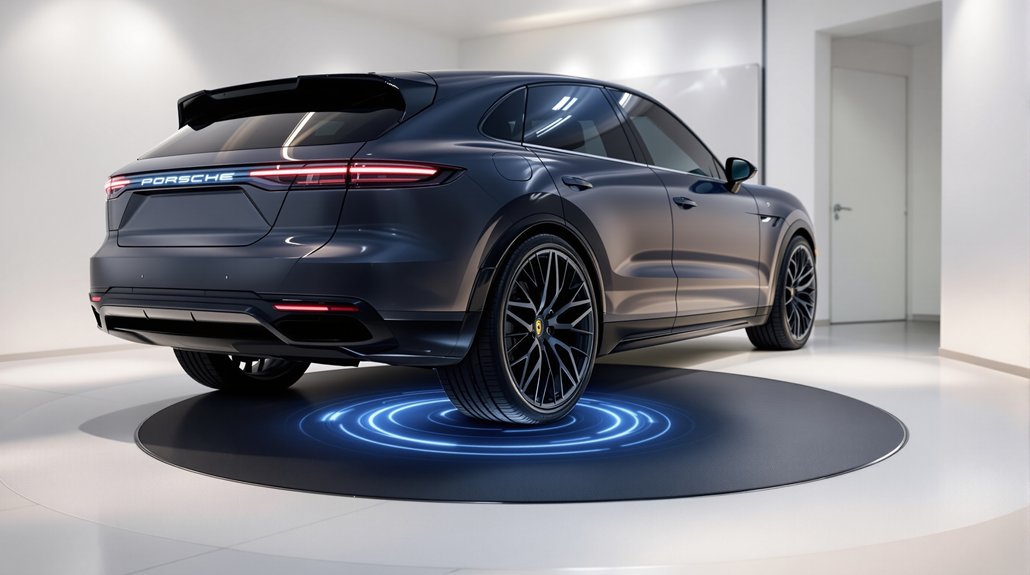
While electric vehicles continue to gain market share, Porsche is tackling one of the persistent inconveniences of EV ownership with its innovative wireless charging system for the upcoming Cayenne EV. The system, which employs inductive charging technology, offers a completely cable-free experience, initiating power transfer automatically when the vehicle is properly positioned over the ground transmitter pad.
The technology delivers an impressive 11 kW charging rate—comparable to premium AC wallboxes—while maintaining approximately 90% efficiency, nearly matching conventional wired solutions. This performance isn’t hampered by environmental conditions, as the system operates reliably in temperatures ranging from a frigid -40°C to a sweltering 50°C, and remains unaffected by snow, water, or debris accumulation.
Porsche’s implementation consists of two primary components: a liquid- or air-cooled ground transmitter pad and a 15kg vehicle-mounted receiver unit. The latter sits protected behind underbody cladding without compromising the SUV’s ground clearance. When parked, the vehicle’s air suspension slightly lowers to optimize the 11-16 cm air gap required for efficient energy transfer.
Porsche’s dual-component charging system features intelligent air suspension adjustment to maintain optimal energy transfer distance without sacrificing clearance.
The user experience is remarkably straightforward. The infotainment system displays green guide lines with top-down camera views to assist with precise positioning. I’ve seen similar alignment systems before, but Porsche’s implementation seems particularly refined.
Safety features include pet and obstruction detection sensors that prevent accidental activation. The system’s intelligent design automatically pauses charging when it detects an animal and resumes 15 seconds after the pet leaves the area. This solution represents a significant advancement in wireless charging technology that industry experts predict will become increasingly important as EV adoption grows.
This convenience comes at a premium price point, with the ground pad costing approximately £3,000 and the vehicle receiver module around £2,000. The complete package may reach £7,000 in the UK market—certainly not chump change, but potentially worthwhile for those seeking the ultimate in charging convenience.
The system’s compatibility with Porsche’s 800-volt PPE platform assures that Cayenne EV owners can choose between high-voltage wired charging or this wireless option. This innovation directly addresses the needs of Porsche owners, as data shows 75% of owners prefer to charge their vehicles at home. For those willing to invest, the ability to simply park and walk away—no cables, no plugs, no hassle—represents a significant step forward in EV ownership experience.