While Spain’s electrical grid has traditionally maintained robust stability parameters, the recent cascading failure that plunged the Iberian peninsula into darkness represents the most significant European power disruption since the 2006 UCTE disturbance. The collapse originated from low-frequency oscillations at 0.2 Hz between Iberia and Central Europe, creating phase differences exceeding 90° that fundamentally destabilized the transmission network. These oscillations, recorded between 12:03:15 and 12:22:03, served as warning signs of the impending catastrophe.
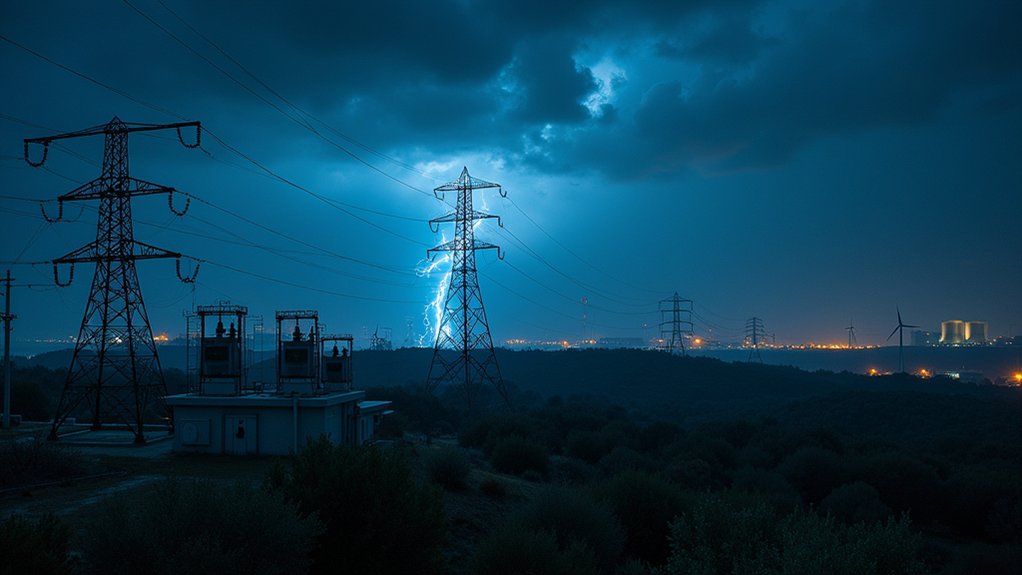
The critical tipping point occurred at 12:32:57 when a mass generation trip of 2.2 GW within just 20 seconds sent frequency plummeting to 48 Hz. I’ve analyzed similar events, but the ROCOF threshold breach of 1.5 Hz/s here created unprecedented turbine stress. Protective relays functioned precisely as engineered, disconnecting the France-Spain overhead interconnections at 12:33:19 to prevent wider European system damage. This isolation, however necessary, sealed Spain’s fate.
Mass generation loss of 2.2 GW triggered catastrophic cascade, isolating Spain’s grid to contain the European-wide disaster.
Contrary to initial speculation, renewable energy sources weren’t the primary failure point. Nuclear plants constituted the primary generation loss, though the grid’s changing dynamics from Baltic and Ukrainian expansions likely contributed to the system’s vulnerability. The protection ecosystem responded textbook-perfect—activation of load-shedding protocols preserved critical infrastructure while sacrificing general distribution. The blackout impacted critical services including trains and ATMs across both Spain and Portugal.
Phasor measurement units detected the anomalies early but couldn’t prevent the cascade. The system’s voltage surges, occurring alongside frequency decline, overwhelmed spinning reserves and stretched protection systems beyond their operational limits. This combination of stressors hasn’t been observed in European grids since pre-2010 incidents. The unprecedented power outage affected approximately 60 million people living in the Iberian region.
Spanish authorities quickly ruled out cyberattack scenarios, confirming the technical nature of the failure. The event bears striking similarities to oscillations observed in 2016 and a2021, though at a slightly different frequency (0.217 Hz versus 0.25 Hz).
Moving forward, grid modernization must balance renewable integration with synchronous generation reliability—a delicate calibration that yesterday’s blackout proves remains elusive. The recovery effort showcases both the fragility and resilience of modern interconnected power infrastructure.