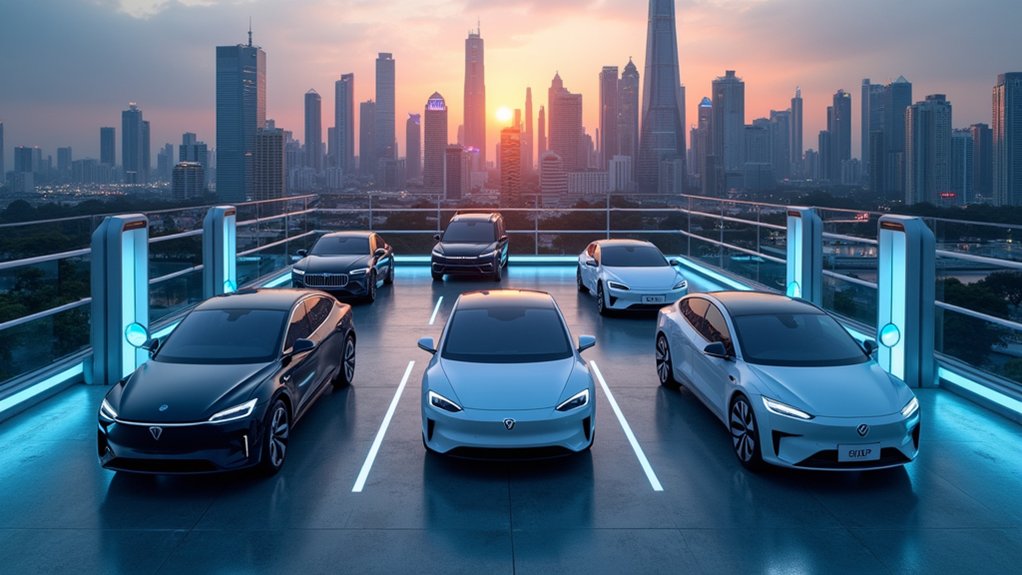
Several major shifts in the electric vehicle landscape have reconfigured the industry’s competitive dynamics heading into 2025, with Chinese manufacturers asserting unprecedented dominance. BYD has decisively captured global EV market leadership with a commanding 15.4% share, overtaking Tesla in both total EV volumes and battery electric vehicle sales. This ascendancy marks a watershed moment in the industry’s evolution, as Chinese manufacturers now occupy three of the top five global positions.
Tesla maintains substantial market presence despite its declining share, which has fallen to 12.4% from 17.6% year-over-year. The Model Y continues its reign as the world’s best-selling EV for the fourth consecutive year, though Tesla’s overall position has been compromised by Geely‘s meteoric rise to a 12.7% market share. I’ve observed that Geely’s strategic model rollout and aggressive overseas expansion have positioned it perfectly to capitalize on Tesla’s stumbles.
The global EV market has matured considerably, now representing 21% of all auto sales in 2025. With the vehicle electrification market valued at $91.6 billion in 2024 and projected to reach $205 billion by 2034, the stakes couldn’t be higher for manufacturers.
Chinese OEMs have leveraged their domestic scale advantages to drive international expansion, with BYD’s diversified lineup serving markets globally. BYD’s comprehensive vertical integration provides significant cost advantages that strengthen its competitive position against both domestic and international rivals. China’s dominance is reinforced by their government incentives that have fueled unprecedented growth in domestic EV adoption.
Western automakers are mounting a response, albeit belatedly. Volkswagen Group has climbed to fourth place with a 7.2% global EV share, outpacing SAIC through strategic partnerships and expanded electric offerings. The ID.4 has ascended EV sales rankings in 2025, signaling VW’s commitment to electrification. Despite this growth, General Motors has shown impressive momentum by nearly doubling its EV sales volume compared to the previous year.
Emerging players like XPeng and Li Auto have carved specialized niches, with XPeng focusing on autonomous driving technology and Li Auto delivering over 500,000 extended-range electric vehicles by 2024.
Model diversity has expanded dramatically, with compact offerings like the BYD Yuan Plus becoming segment leaders. The industry’s transformation continues at breakneck pace, permanently altering automotive power dynamics.