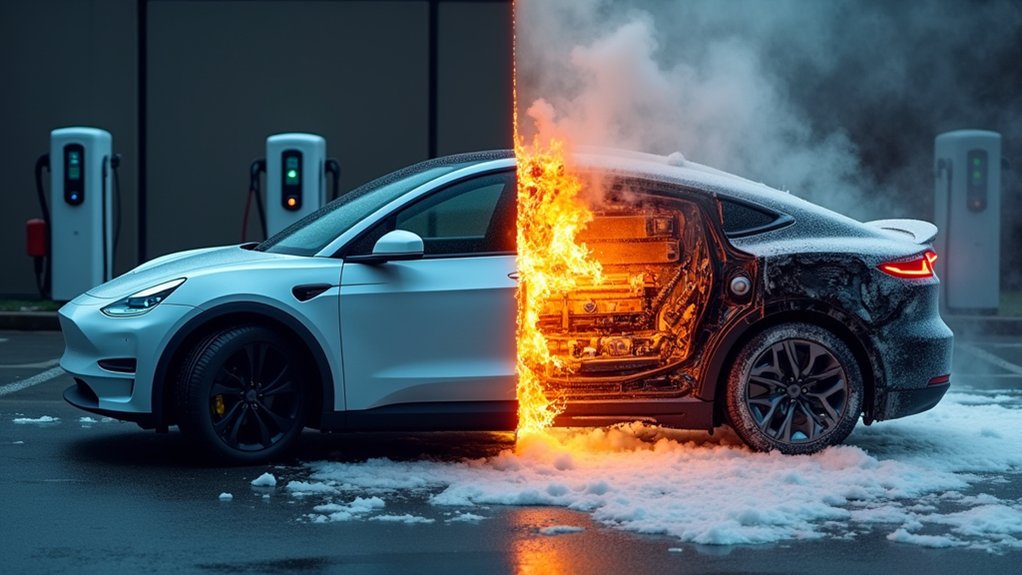

While electric vehicles continue to gain market share globally, the automotive industry faces critical challenges regarding battery safety as recent incidents highlight both the current statistical advantages and future risks of EV propulsion systems. The data tells a compelling story: EVs currently experience fires at a rate 20 times lower than internal combustion vehicles, with Tesla reporting one fire per 130 million miles versus conventional vehicles’ one fire per 18 million miles.
Yet January 2025’s surge in lithium battery incidents suggests complacency would be misguided. The contradiction between current safety statistics and projected risks stems from fundamental battery architecture issues. Despite three decades of innovation in energy density and cost reduction, battery designs retain core vulnerabilities.
Safety statistics paint a rosy picture while EVs harbor silent architectural risks beneath their modern exteriors.
I’ve observed that higher energy density cells, while extending range, inherently pack more combustible materials into tighter spaces—creating perfect conditions for thermal runaway when protections fail. By 2030, the global EV fleet will expand sixfold to approximately 250 million vehicles.
Applying conservative failure rates of one fire per 10,000 EVs yields a sobering projection of 25,000 annual thermal incidents. These aren’t ordinary vehicle fires; they’re exceedingly difficult to extinguish, requiring specialized firefighting techniques and resources. With fewer than 400 verified battery fires globally from 2010 to June 2023, the current numbers remain low, but could increase dramatically as adoption grows. The incidents frequently occur during charging or while parked, presenting unique hazards.
Manufacturers face enormous financial pressures from fire-related recalls, with costs reaching $1 billion per vehicle line. The industry is beginning to shift toward fundamental safety redesigns rather than manufacturing controls. 24M’s Impervio separator technology exemplifies this shift, demonstrating remarkable stability during overcharging tests that cause conventional separators to short and ignite.
The challenge facing automakers parallels aviation’s safety evolution—balancing performance with acceptable risk profiles. Despite EVs’ statistical safety advantages over conventional vehicles, public perception remains highly sensitive to dramatic thermal events. The January 16 incident at Moss Landing facility demonstrated how severe lithium battery fires can be, with toxic metal releases and evacuations affecting over a thousand residents.
Successfully maneuvering the shift to electrification requires not only improving energy density and reducing costs but fundamentally rethinking battery safety architecture before the projected surge in incidents materializes. Modern Battery Management Systems (BMS) play a crucial role in preventing fires by constantly monitoring cell voltage levels and temperature fluctuations across all battery modules.