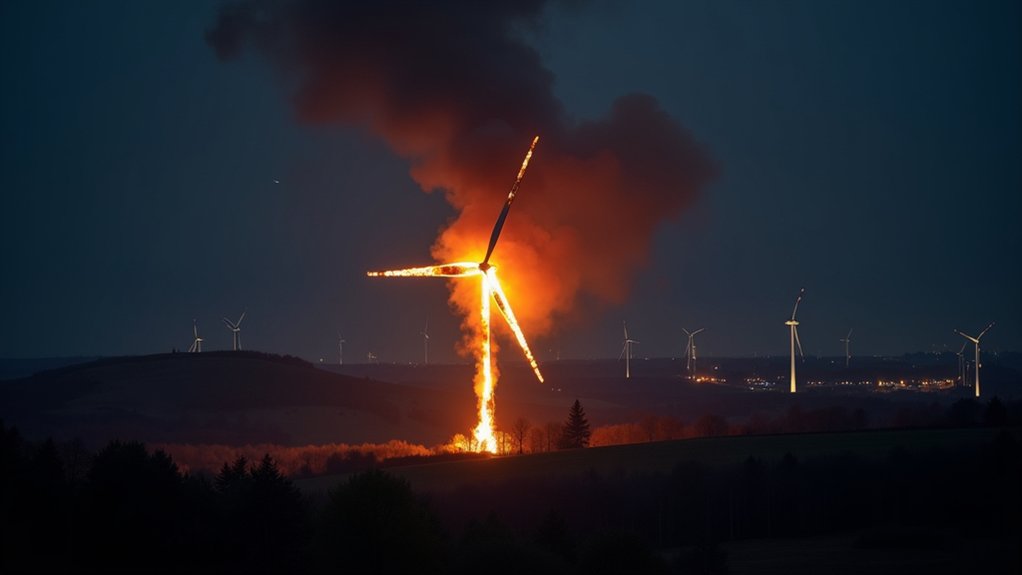

While Germany continues to lead Europe in renewable energy adoption, recent incidents involving wind turbine fires have ignited fresh debates about the safety and reliability of these technologies. The timing couldn’t be more challenging for the renewable sector, which recently experienced a significant production downturn despite infrastructure expansion.
Renewables provided 46.9% of Germany’s electricity consumption in Q1 2025, but total generation fell by 16% compared to the same period last year. Wind power, which usually covers about a quarter of Germany’s gross electricity consumption, has been particularly affected. The installation of 872 new turbines, adding 4.3 GW of capacity, wasn’t enough to overcome historically weak wind conditions.
Despite record turbine deployment, Germany’s renewable output dropped 16% as weak wind conditions overwhelmed capacity additions.
Offshore wind production plummeted by 31% while onshore generation dropped 22%, creating a perfect storm for critics questioning renewable reliability. The recent turbine fire, while statistically rare, has amplified concerns about safety protocols. I’ve observed that media coverage of such incidents can significantly influence public perception, despite fire risk in wind turbines being demonstrably low relative to deployment numbers.
The challenge is maintaining public support in the face of isolated but visually dramatic failures. Germany’s regulatory framework mandates strict safety standards for renewable installations, with regular inspection requirements for wind farms. Clear communication on the costs and benefits of the energy transition is essential to address public concerns about renewable safety. Nevertheless, the adequacy of these standards becomes a flashpoint for debate following each incident, complicating the social acceptance of new projects.
The temporary renewable shortfall has forced an unwelcome 10% increase in fossil fuel generation, highlighting the integration challenges that persist in Germany’s energy shift. This situation has led to coal-fired plants becoming the primary source of on-demand electricity when wind production falters. Backup systems, mainly fossil-based, remain necessary to guarantee grid reliability during low wind periods.
Despite these challenges, the fundamental safety record of renewables remains strong. The occasional turbine fire, while concerning, must be viewed in context of the thousands of units operating without incident. For Germany’s energy shift to succeed, addressing both the technical challenges of variability and the public perception of safety will be equally critical.